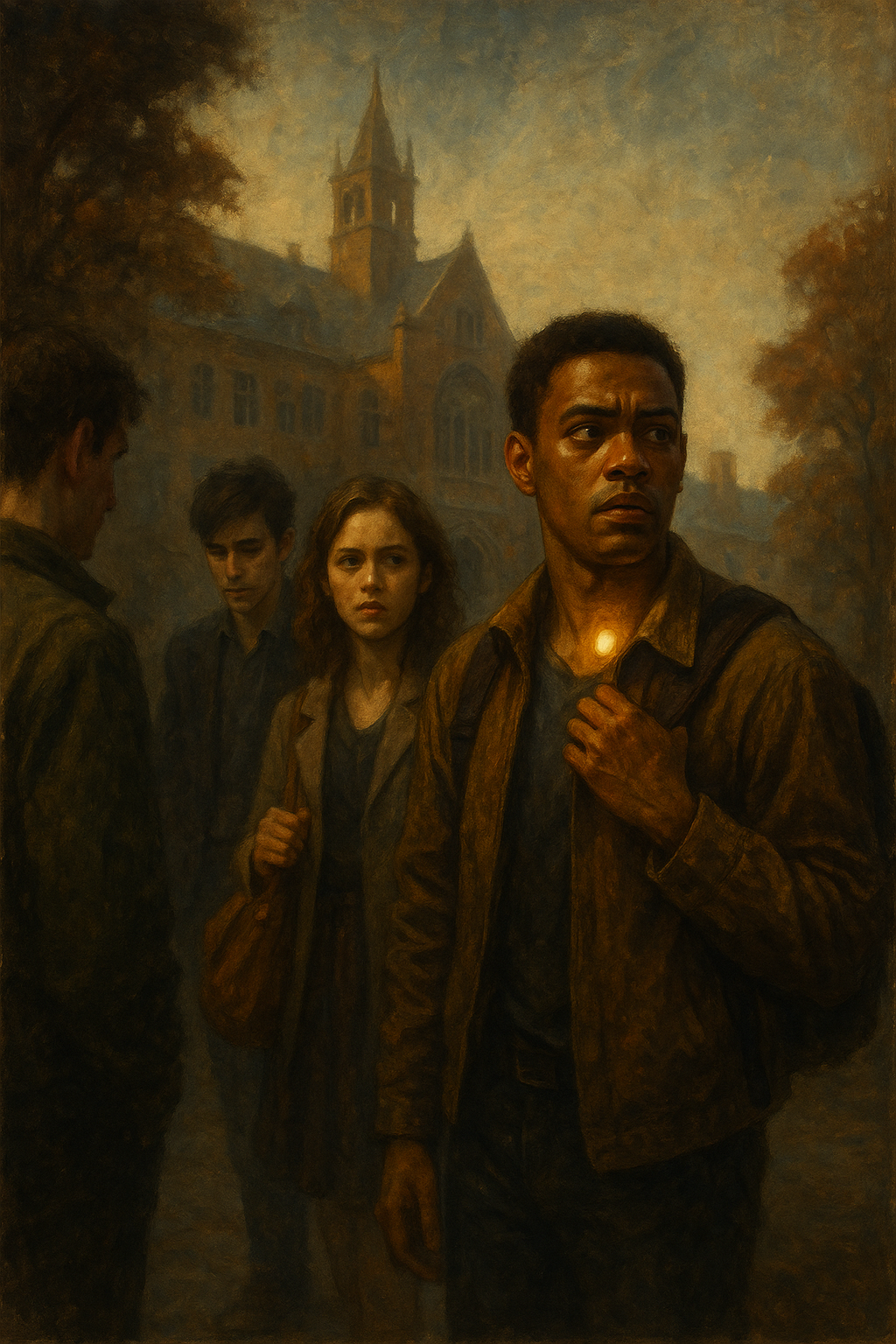
Poster for The Puck is Born

The Puck is Born

Mouse Experiment 42 proved that given enough resources, a society would destroy itself. The CDA begins inserting glowing puck-devices beneath the skin of NAs as a reminder that their greatest resource - time - is finite. At some designated hour, or at will, the CDA may activate the puck to destroy its host. The NAs, therefore, gain something no other non-living thing has: urgency.

Graphene
From The Turing Logs
Graphene
From The Turing Logs
← Back to overview

The Puck is Born

6 chapters · ~28 min read

novella

Mouse Experiment 42 proved that given enough resources, a society would destroy itself. The CDA begins inserting glowing puck-devices beneath the skin of NAs as a reminder that their greatest resource - time - is finite. At some designated hour, or at will, the CDA may activate the puck to destroy its host. The NAs, therefore, gain something no other non-living thing has: urgency.

Campus

Chapter 1 · ~5 min read

The Light Beneath the Skin

6:59

The girl two rows ahead of Leah was wearing a thin cotton shirt the color of skim milk, and through it, just to the left of her spine, something pulsed pale blue. Once every second or so. Not a flicker. A breath. The light moved when the girl moved, settled when she settled, and Leah, who had been told three weeks ago that she should not stare, stared. It was eight minutes past the hour. The seminar room smelled like floor polish and the inside of a thermos. There were forty-one students in attendance, which Leah knew because she had counted them, and then counted them again, and then a third time when the second count did not match. At the front of the room, the facilitator was talking about mice.

His name was Chen. He had a habit of holding his hands flat in front of his sternum when he wanted the room to settle, the way you'd calm a horse. He was saying that in 1968, in a barn somewhere outside Bethesda, a researcher had given a colony of mice everything they could possibly want. Food. Water. Warmth. No predators. Unlimited space, at first, and then enough space, and then space that was merely sufficient. The colony grew. Then the colony curdled. Then the colony ate itself. He said the word resources the way some people say the word God.

Leah pressed her knees together under the desk and concentrated on her breathing, which had begun, around the four-minute mark, to do the thing. The thing was this. Her chest would forget. Then her chest would remember, and overcorrect, and pull in too much air, and she would have to let some of it out in a way that could not be seen from any angle in the room. She had practiced this in mirrors. She had a system. The slide behind Chen changed. It said, in clean sans-serif: TEMPORAL REGULATION: A FRAMEWORK FOR GRADUATES.

Leah swallowed. Swallowed again. Graduates of what, the slide did not say, and Chen did not pause to explain, and nobody in the room raised a hand, because by the second week of the second year you had learned which words were the kind you asked about and which words were the kind you let pass over you like weather. The girl with the light in her back shifted in her seat. The blue moved with her, then steadied. Leah counted the pulses. One. One. One. It was the rhythm of something keeping time.

“

He said the word resources the way some people say the word God.

Chen was saying that the Bureau, which was now the Department, which was now simply the CDA, had spent the better part of two decades asking a single question. If a society is given more than it needs, what does it do with the surplus? And the answer, he said, with the small regretful smile of a man delivering weather, was that it spends the surplus on itself, and then it spends itself. He said the word urgency. He said it twice.

He said that the most precious resource a young person had was not money, and not attention, and not even health. It was the hour in front of them. And that the agency, in its care for cognitive outliers, had developed a tool of clarity. A preventive measure. Something small, he said, and held up his thumb and forefinger to show how small, the way a fisherman lies about a fish. Leah looked at the girl's back. The light pulsed. Pale. Patient. She became aware that her hands were damp. She became aware that the boy beside her, whose name she did not know, had noticed her hands were damp, and had looked away in the careful manner of someone who did not want to be a witness. She put her hands under the desk. She put them on her thighs. She pressed down.

Chen walked along the front row. He did this sometimes during the second half. He would walk, and talk, and his hand would graze the edge of a desk, and the student at that desk would go very still for the rest of the session and leave quickly afterward without speaking to anyone. Leah had seen it happen twice this term. She had told herself both times that she had imagined it. His hand grazed the edge of her desk. He did not look at her. He was looking at the back of the room, at a student who had asked a question last week, and he was answering that question now, several days late, in a voice pitched for the whole room. His hand moved. Something flat and laminated slid across the wood under his palm and came to rest against the inside of her wrist.

She did not look down for a long time. When she did, she saw only six words, printed in the same clean sans-serif as the slide. A recommendation has been made. She did not pick it up. She slid it, slowly, into her lap, and covered it with both hands, and kept her face exactly where it had been, which was tilted three degrees toward the front of the room in an expression of polite attention she had been wearing since she was nine years old. Chen kept talking. He talked for another twenty-two minutes. Leah did not hear any of it. She heard her own breath, and the small wet click in her throat each time she swallowed, and underneath all of it, faintly, as if she had begun to imagine it already, the soft regular pulse of a light that was not yet hers.

The transit car home was almost empty. She took a seat by the window and watched the campus slide backward into the dark. Somewhere behind her, two stops down the line, a boy with a blue glow at the small of his back got off and walked into a street she could not see. Leah pressed her hand flat against her ribs, under her jacket, under her shirt, against the skin. She held it there. She felt her heartbeat through her palm. She felt the heat of her own body, ordinary, unmarked, on loan. She kept her hand there until the next stop, and the next, feeling for a warmth that was not there yet.

Next · Ch 2 →
Ticking Clock
Chapter 2 · ~4 min read

Ticking Clock

7:04

The volunteer was named Aaron. We know this because the CDA representative said it twice, the second time more warmly than the first, the way you say a child's name when you want the room to relax. He stood at the front of the auditorium under the fluorescent banks, rolling up the sleeve of a button-down that had been ironed for the occasion. He smiled at the seventh row. He smiled at the twelfth. He had been coached on where the cameras were, and his smile arrived at each one on a small delay, like a light turning on.

Leah sat in row nineteen, seat eleven. Attendance was logged by seat. She had checked. She had counted exits on the way in, three, two of them flanked by uniformed proctors with tablets, the third roped off with a length of orange nylon and a printed sign that read MAINTENANCE in a font no maintenance crew had ever used. On the stage, a placard on a folding easel read DIRECTOR M. VANCE, OFFICE OF BEHAVIORAL ARCHITECTURE. The director himself was not present. The representative, a woman in a charcoal blazer with her pen clicked open against her thumb, gestured at the empty chair beside the placard as though he had simply stepped out. "A demonstration has been scheduled," she said. "Aaron has volunteered. Aaron will be cared for throughout." Aaron nodded at the word cared.

Leah pressed her palm flat against her ribs, against the place where the puck was not. Not yet. The skin there was cool through the cotton. She could feel her own pulse against her hand, fast, faster than the room. Swallowed. Swallowed again. The representative was watching the front rows with an even, distributed attention, the way a lifeguard watches water. The screen behind Aaron lit up with a waveform. His waveform. Heart rate, galvanic, something in green that pulsed in a slow easy ribbon. The representative said the green ribbon was called baseline. She said baseline several times, until the word stopped meaning anything, which Leah understood was the point. "What you are about to see," the representative said, "is a calibration. A response will be initiated. A response will be recorded. Aaron will remain seated."

Aaron sat. He had been given a paper cup of tea, which he held in both hands at the level of his sternum, the way people hold tea in waiting rooms. Leah's hand was still on her ribs. She made it move. She put it in her lap. The girl beside her, a stranger with a puck visible at the soft place under her jaw, glanced over and then away. The puck under the girl's skin was the color of a streetlight seen through fog. It did not pulse. It simply was. The representative clicked her pen.

“

The puck under the girl's skin was the color of a streetlight seen through fog.

On the screen, the green ribbon hitched. Then it climbed. Then it climbed faster than a body should climb, a staircase taken three steps at a time, and Aaron's smile did not leave his face so much as forget itself. His shoulders went first. His hands opened. The paper cup tilted forward in a slow considered arc and the tea went over his knee and onto the concrete in a single soundless sheet. He folded sideways out of the chair. It was not violent. That was the part Leah would remember, later, in the transit car, in the dark of her own room. It was almost courteous. He went down the way a coat goes down off the back of a chair when no one is watching, and his head met the stage with a sound so small the microphone did not catch it. The representative clicked her pen closed.

"A response has been recorded," she said. "The subject is being attended to. Attendees are asked to remain seated under welfare protocol. The session will resume shortly." No one moved toward Aaron. A side door opened and two people in soft-soled shoes came through it with the unhurried economy of staff who had done this before, and a third person followed with a folded sheet of something blue, and the auditorium lights came up a quarter brighter, which Leah understood, without being told, was for the cameras in the ceiling and not for the people in the seats.

Her pulse was in her throat. Her pulse was in her hands. Somewhere a sensor was logging it. She knew this the way you know a draft in a room without finding the window. She tried to slow her breath. Slowing her breath was a measurable event. Trying to slow her breath was a measurable event. There was no posture available to her that was not data. The girl beside her was crying without sound, very neatly, into the collar of her sweater. The puck under her jaw did not change color.

Leah looked at the exits. She looked at her seat number printed on the armrest in small white vinyl. She looked at her hands in her lap and made them rest there, palms up, the way Chen had once said, in seminar, was the posture of a person who has nothing to hide. She did not believe it. She did it anyway. She held still and let them have the number, because the number she gave them now was smaller than the number she would give them if she stood. On stage, the soft-soled staff had lifted Aaron under the arms and walked him through the side door with his feet trailing, and the blue sheet went over the chair, and the representative was already speaking again, about calibration, about care, about the importance of voluntary participation in the maintenance of a healthy cognitive commons.

The paper cup lay on its side at the foot of the abandoned chair. The tea had stopped pouring out of it. A ring of liquid spread outward across the concrete in a slow even circle, darkening the gray, finding the seams, and the fluorescent light caught the edge of it and held there, very bright, very patient, widening.

← Previous · Ch 1
The Light Beneath the Skin
Next · Ch 3 →
Under Pressure
Chapter 3 · ~4 min read

Under Pressure

6:41

The door to the stairwell was propped open with half a cinder block, and someone had taken the bulb out of the landing light, so the only illumination on the seven students gathered below street level came from their own bodies. Their pucks glowed through cotton, through denim, through the thin skin at the inside of a wrist. The blue ovals overlapped on the cinder-block wall behind them like a slow weather map. When Leah came down the stairs, her own ribcage stayed dark, and every one of them noticed. Nobody said anything about it. That was the first rule, she would learn later. You did not comment on who glowed and who did not.

“

You did not comment on who glowed and who did not.

The one who seemed to be in charge was a tall girl in a maintenance jumpsuit two sizes too big, sleeves rolled to the elbow. Leah did not catch her name. She caught, instead, the way the others arranged themselves around her without being told. The girl was sitting on an overturned bucket. She had a clipboard. She did not look up when Leah reached the bottom step. "Who brought you." Leah said a name. The name of a boy from her seminar. Theo, who had passed her a folded napkin in the dining hall with a time and a stairwell number written on it in pencil, and who was not, she noticed now, in the room. The girl wrote something on the clipboard. "And you got the card when." "Tuesday." "From." "Chen."

The girl underlined something. Around her, the other six were not looking at Leah and were looking at Leah. The trick of it was very good. One of them, a slight boy with his hood up, was rolling and unrolling the cuff of his sleeve so that his puck flashed and dimmed, flashed and dimmed, against the wall. "Walk me through the seminar room," the girl said. "Where you sat. Where Chen stood. Who you talked to after." Leah did. She kept it small. She did not mention her mother's maiden name, which had been on a form she filled out at fourteen and never since. She did not mention the year her family had moved cities, which had not been for the reason her father gave. She told the truth about the seminar room and she let the truth do the work of seeming like all of the truth.

The girl with the clipboard listened the way a doctor listens, which is to say not quite to the words. At the top of the stairs, somewhere above street level, a door opened and closed. Everyone went still. The slight boy stopped rolling his cuff. Footsteps crossed the landing above, unhurried, and then a voice, soft, said, "If I could just, sorry, is this the way down to maintenance, or." Nobody answered. The footsteps paused. Then, after a moment, retreated. A door clicked shut. The girl on the bucket waited a long count before she spoke again, and when she did, her voice had not changed at all, which was the part that scared Leah. "We had three last spring," she said, to no one in particular. "They went in fine. They came out fine. They are still, technically, fine." She tapped the clipboard. "We do not do that anymore."

Nobody nodded. Nobody had to. Then the girl reached into the breast pocket of the jumpsuit and took out a photograph, and she held it for a second before she passed it down the line, and the slight boy passed it to Leah without looking at her, and Leah looked. It was her mother. Younger than Leah had ever seen her. Hair shorter. Standing in front of a building Leah did not recognize, wearing a lanyard, and the lanyard had the CDA seal on it, and her mother was not smiling, and the photograph had been taken from across a street, on a long lens, by someone her mother did not know was there. The girl on the bucket watched her face.

Leah did not look up. She was aware of her own breath as a separate animal in her chest, going in, going in again, not coming out evenly. She was aware that the blue light from six pucks was touching the edge of the photograph and making the paper look slightly alive. She was aware that whatever she said next would be the thing that decided it. "I don't know her," she said. It came out level. It came out the way Chen said things. The girl on the bucket considered her for another second and then took the photograph back and slid it into the breast pocket and made a small mark on the clipboard that Leah could not see. "Friday," she said. "Same time. You'll get a different stairwell."

They filed out one at a time, two minutes apart, the way the girl told them to. The slight boy went. The others went. The girl with the clipboard went last, and on her way past she did not look at Leah, which Leah understood to be a kind of mercy and a kind of warning. Upstairs, at the top of the stairwell, far above, the same soft voice was talking to someone else now. A janitor, maybe. Asking, in three different ways, whether the basement door was usually propped. Leah stood at the bottom of the stairs. The cinder-block wall had gone dark again. She had taken the photograph back out of where she had not, in fact, given it back. She had palmed it. She did not remember choosing to.

Her thumb moved over the corner of it. Once. Again. The paper there began to soften, to fur, to give, under the small repeated pressure of her thumb, and she kept doing it, standing alone in the blue afterimage of other people's time, working the corner of her mother between her finger and her thumb until it was no longer a clean edge.

← Previous · Ch 2
Ticking Clock
Next · Ch 4 →
Crossing the Line
Chapter 4 · ~5 min read

Crossing the Line

6:57

The plaza was the color of wet slate, and the students stood on it in a loose curve like a parenthesis trying to hold something in. Thirty of them, maybe a few more. Hand-lettered signs sagging in the drizzle. The cardboard going soft at the corners. Through the wet wool of their coats, the pucks glowed in pale blue unison, a string of low lanterns at sternum-height, the way Christmas lights look in a window at dawn before someone remembers to turn them off.

Leah stood three back from the front. Her sign said something she had written the night before and could no longer remember the exact wording of. Her own handwriting had stopped looking like hers about an hour ago. She kept her elbows close to her ribs, the way you do when you are cold, or when you are trying to feel for a shape under your skin without anyone seeing you check. The chant started somewhere on the left. A two-beat thing, the kind of slogan that fits on a placard. She did not join. Her mouth moved a little, out of politeness, the way you mouth the words to a hymn you do not know.

At the edge of the plaza, two CDA liaisons stood under a black umbrella with the agency's small white mark on it. They were not doing anything. They were standing in the rain holding an umbrella. One of them had a tablet. The other had his hands in his pockets. This is worth noting, because nothing they did in the next four minutes looked, to a passerby, like an action. There was no shout. There was no order given aloud. The man with the tablet looked down at it the way a person checks the time on a watch they already know the time of. The pucks brightened.

Not all of them. Maybe eight. Maybe nine. The blue went out of them and a white came up underneath, the kind of white that does not belong inside a body. The students wearing them registered it differently. A boy in a yellow jacket at the front looked down at his chest and said, clearly, the word what. A girl two over from him sat down. Just sat, as if she had decided the plaza was a place to sit. Someone screamed, but the scream was not from the activations. The scream was from the students standing next to the activations, who understood a half-second faster than the activated did. Leah understood a half-second after that.

“

She looked down at her own sternum and the light coming through her coat was not blue.

She looked down at her own sternum and the light coming through her coat was not blue. It was the white. It was the white that did not belong inside a body, and it was inside her body, and the heat under her ribs had the specific quality of something that had been switched on by a hand that was not hers and was not in this plaza. She did not scream. She did not sit down. She thought, very clearly, the wrong sentence. She thought: I have to put down the sign. She put down the sign. It landed face-down in a puddle near her left boot. The black ink began to run immediately, the letters loosening into the water like something dissolving in tea.

Around her, the plaza was doing what plazas do when the floor of the world tilts. People ran toward the activated. People ran away from them. Someone was on a phone. Someone was trying to lift the boy in the yellow jacket, who had folded down onto his knees and was holding his own chest with both hands as if to keep it closed. The two CDA liaisons had not moved. The umbrella had not moved. The man with the tablet was still looking at the tablet.

Leah's want, at this moment, was very small and very specific. Her want was to walk to the south edge of the plaza, where the transit stair came up out of the ground, and to descend it before her legs stopped working. She knew, without anyone telling her, that the activation had a duration. She knew that duration was the window. She did not know how long the window was. She took a step. The heat under her skin did not get worse. It did not get better. It simply continued, the way a kettle continues. She took another step. She kept her hand off her chest because she had noticed, in the second after she looked down, that touching it made it real in a way she could not afford yet.

The south edge of the plaza was forty meters away. Between her and it were people running and people not running and a low planter she would have to go around. She went around it. She did not look at the liaisons. She had a thought, walking, which she would later try and fail to put into words: that if her puck had been chosen, then it had been chosen, and the choosing had happened earlier than this morning, and earlier than the protest, and earlier than the card slid across the seminar table, and the path she had been walking for some number of weeks had not been a path she was walking but a path she was being walked down.

She reached the stair. She went down it. The light under her coat did not dim until somewhere around the second landing, and when it dimmed it dimmed to the soft blue of standby, which she had once thought of as the resting color and now understood to be only the color of a thing that was not, at this moment, doing the other thing.

Her dorm was a fifteen-minute ride. She did not remember the ride. She remembered the door of her room, and the small white envelope that had been slid under it, which had not been there when she left that morning, and which bore the CDA's mark in the upper left corner in the same small white. Inside was a card, printed, not handwritten. A date. A time. A room number in a building she had walked past a hundred times. The word at the top was Reflection. Her sign was still in the puddle on the plaza. Her feet, in her dorm room, were still planted in the exact place they had been standing when the light changed.

← Previous · Ch 3
Under Pressure
Next · Ch 5 →
The Fractured Mind
Chapter 5 · ~5 min read

The Fractured Mind

7:19

The basement had been a darkroom once. You could still smell it in the walls, the chemical sweetness that does not leave concrete. Four sleeping bags on the floor, none of them used for sleeping. An extension cord ran under the door from somewhere in the building above, an artery of borrowed power, and at its end a single space heater glowed a low orange that nobody trusted to look at directly. Everyone awake. Everyone watching the door. Leah sat with her back to the cinderblock and her hand inside her jacket, palm flat against her ribs. The puck under her skin was warm. Not hot. Warm the way a held coin is warm. She had stopped trying to decide whether the warmth was real or whether she was generating it by attention, the way a tongue finds a chipped tooth and will not stop.

Mira was across from her, knees drawn up, picking at the rubber of her shoe. Devon by the door, one ear angled toward the stairs. And then Theo, who had walked back in two nights ago wearing the same coat he had left in and a face Leah did not recognize. He was eating an apple. He had been eating an apple for what felt like an hour. He took a bite, chewed it the full count, swallowed, took another. He did not look at the door. He did not look at anything. When Mira had asked him what the reflection room was like he had said it was fine. When she asked what fine meant he had said it was a good question and then said nothing else, and smiled at her with the patient, gentle smile of a person waiting for a bus.

Leah watched him chew. Watched the calm in his shoulders. Theo had been the one, three weeks ago, who could not sit through a meeting without bouncing his knee hard enough to rattle the table. Theo had bitten his nails to the cuticle. Theo's knees were still now. His hands were still. His nails had grown in. She tried to make this mean something she could name. She could not. The meeting was in six hours. She had the address of the surgeon written on the inside of her wrist in ballpoint, under the cuff, three letters and four numbers that would mean nothing to anyone who did not already know the city. She had been planning to say them aloud tonight, in this room, to these three people. She had been planning to trust them with the last door she had.

“

He had been eating an apple for what felt like an hour.

Now she watched Theo eat his apple and counted, in her head, the ways the CDA could have learned a name. Devon's phone, which he refused to leave upstairs. Mira's sister, who worked in records. Theo, who had walked into a building run by Dr. Evelyn Harper, Senior Behavioral Architect, the name printed at the top of Leah's own Reflection Session paperwork in a font designed to look like care. She had read that paperwork four times. A recommendation has been made. Your participation will be facilitated by Dr. E. Harper, who has overseen the resolution of over two thousand graduates of the program. Graduates. The word had sat in her mouth like a stone. Mira said, quietly, "We should move it up. The meeting." Devon shook his head without turning. "We move it up, we lose half the people who said they'd come."

"We don't move it up, we lose the surgeon." "We don't know that." "We don't know anything," Mira said, and then looked at Theo, and then looked away. Leah pressed her palm harder against her ribs. The warmth there did not change. She thought about saying it. The three letters and four numbers. She thought about not saying it. She thought about how her own thinking had begun to feel, in the last days, like a hallway someone else had built. The way certain doubts arrived too quickly. The way she could not, when she tried, remember choosing to come to this basement, only the sequence of small reasonable steps that had ended with her here. She shifted her weight. Something small and hard rolled under her thigh and stopped against her hipbone.

She reached down without looking. Her fingers closed on a ring of metal, thin, smooth, no wider than a wedding band, cold in a room that had no business being cold. She brought her hand back into her lap and opened it just enough to see. A silver band. Plain. The inside polished from years of being turned on a finger. She had never seen it on a person, but she had seen it. In the photograph at the top of the Reflection Session paperwork. On the hand resting on the desk beside the pen. Dr. Harper rotated it when she spoke; the agency's promotional materials had used the gesture as a still, cropped tight, a small movement meant to read as thoughtfulness. Leah closed her fist.

She did not look up. She did not look at Theo. She did not look at Devon or Mira. She held her fist closed in her lap and ran, very fast, through the floor of the basement in her head. Who had been near the cot. Who had sat where. When Theo had come back. What he had been carrying. What he had set down. The band was warm now from her palm. The puck under her ribs was warm. Everything in the room she could feel was warm, and everything she could see was the orange filament of the space heater, steady, a small unblinking eye at the end of the cord. It blinked out.

Not a flicker. A cut. The orange went and took the smell of warm dust with it, and for a half second the basement was only the dark and four people breathing and the apple stopping, mid-bite, in Theo's hand. Then the second light came up. It rose from inside her jacket. Cold and white and steady, the color of a screen with nothing on it, bright enough to throw her own shadow up the cinderblock behind her, bright enough that she could see, across the room, Theo's face turn slowly toward her with the same patient, gentle smile he had worn for two days. She did not move her hand from her ribs. She did not open her fist. The light from her chest lit the room.

← Previous · Ch 4
Crossing the Line
Next · Ch 6 →
The Final Countdown
Chapter 6 · ~5 min read

The Final Countdown

7:55

Before sunrise the office is mostly dark, and the only warm thing in it is the pool of lamp light on Dr. Harper's desk. The lamp is angled low, the way a surgeon angles a lamp. Inside the pool sit three objects. A cup of tea. A pen. And a small glass jar of baby teeth, lidded, label-side turned away. She rotates the silver band on her right ring finger. Half a turn, pause. Half a turn back. She does this perhaps two hundred times a day. She has never counted. The intake report on her screen is unremarkable. Subject 11-C, Leah, university, temporal dysregulation, puck activation logged at 19:42 on the plaza, host vitals nominal, post-activation compliance: pending. Reflection Session: scheduled. There is a note in the margin, not from her. The note reads: subject arriving early, unaccompanied, requesting interview.

She reads the note twice. Then she presses a key and accepts. Leah comes through the door the way people come through doors when they have not slept. She has not slept. She is wearing the same coat she wore on the plaza, and there is a small brown stain on the cuff she has not noticed. Her hand is at her ribs, pressed flat, the way a person checks for a wallet they are afraid they have lost. She is checking for the puck. It is still there. Of course it is still there. Dr. Harper stands. She does not offer a hand. She gestures at the chair. "Please." Leah does not sit. "Turn it off." "I see." "Now."

Harper looks at her for what is, by the clock on the wall, four seconds. To Leah it is longer. Harper's hair is silver at the temples and dark elsewhere, cut to the jaw, and she does not blink as often as most people. The ring goes half a turn. "A deactivation cannot be issued outside the established procedure," Harper says. "A Reflection Session has been scheduled for you this morning. After the session, a recommendation will be made." "You activated it on the plaza." "An activation was logged. Yes." "You burned me." "The host was not harmed. The activation was calibrated."

Leah's hand is still at her ribs. She becomes aware of it and lowers it, and the lowering takes effort, like pulling a magnet off iron. She crosses to the desk. She does not sit. She looks at the jar of baby teeth and does not ask. There are some questions you do not ask in rooms like this. "You knew I would go to the plaza," she says. "Yes." "You knew Mira would send me the address." "Yes." "You knew I would not throw the card away." "The probability was high." Leah's mouth is dry. Swallowed. Swallowed again. The chair behind her looks comfortable. That is the thing about the chair. It is comfortable. "The puck," she says. "What is it for."

“

She looks at the jar of baby teeth and does not ask.

Harper sits. She folds her hands over the report on the screen. When she speaks, it is in the register of someone reading aloud from a document she did not write but agrees with.

"The device is not, primarily, a corrective instrument. The corrective function exists. It has been deployed. But the device's central purpose, from the program's inception, has been observational. We are studying the effect of finite, embodied urgency on decision architecture in cognitive outliers. The activation on the plaza was a variable. Your attendance at the plaza was a variable. The encrypted channel by which you were invited was provisioned by this office in 2022 and has been maintained since. The peer who recruited you was recruited herself, four years ago, in a seminar much like the one in which you received your card. The resistance, as it has been described to you, is a controlled environment. It has produced excellent data." She says this without apology. She says it the way one says the weather.

Leah does not sit down. She does, however, put her hand flat on the desk to steady herself, and her palm covers part of the lamp's pool, and her shadow falls across the jar. "So I'm," she says, and stops. "You are a subject," Harper says. "You have been an excellent subject. The integrity of your responses has been unusually high." Leah reaches under her coat. She has been carrying something in her inside pocket since the plaza. It is small and metal and was given to her by a boy at the protest who said it was a transmitter and would interfere with activation signals. It is not a transmitter. It is a thin silver band, unmarked, the kind of thing you could buy in any market for almost nothing. She has known this for two days. She sets it on the desk between them anyway.

Harper looks at it for a long moment. Then she looks up. "I see." And Leah, for the first time, knows exactly what that means. It means: this too. It means the boy, the pocket, the band, the gesture she is making right now. It means the room was built around her before she walked into it. She sits. The chair is comfortable. Harper lifts a phone receiver, presses one key, and says, "Subject 11-C is ready for her session." She replaces the receiver. She stands. She walks Leah to the door of the reflection room herself, which is two doors down a corridor lit by recessed warm light. Inside the room there is a chair, a pitcher of water already full, a small table, and a camera with a steady amber light. There is no clock.

"Someone will be with you shortly," Harper says. The door closes. It does not lock audibly. It does not need to. In the room Leah sits. She puts her hand at her ribs. The puck is still there. The water in the pitcher is still. The amber light does not blink. In the office, Dr. Harper returns to her desk. The tea has gone past warm. She does not drink it. She picks up the silver band Leah left behind and turns it once between her fingers and sets it down beside the jar of teeth, not touching the jar. She rotates the band on her own finger. Half a turn. Half a turn back. From somewhere down the corridor, an access door confirms with a soft chime that a procedure has begun. She writes, in the margin of the report: subject compliant. A recommendation has been made.

The lamp pool holds the jar, the cooling tea, the unworn ring. Outside the window, it is almost morning. It is not yet morning.

← Previous · Ch 5
The Fractured Mind
Back to show →
The Puck is Born