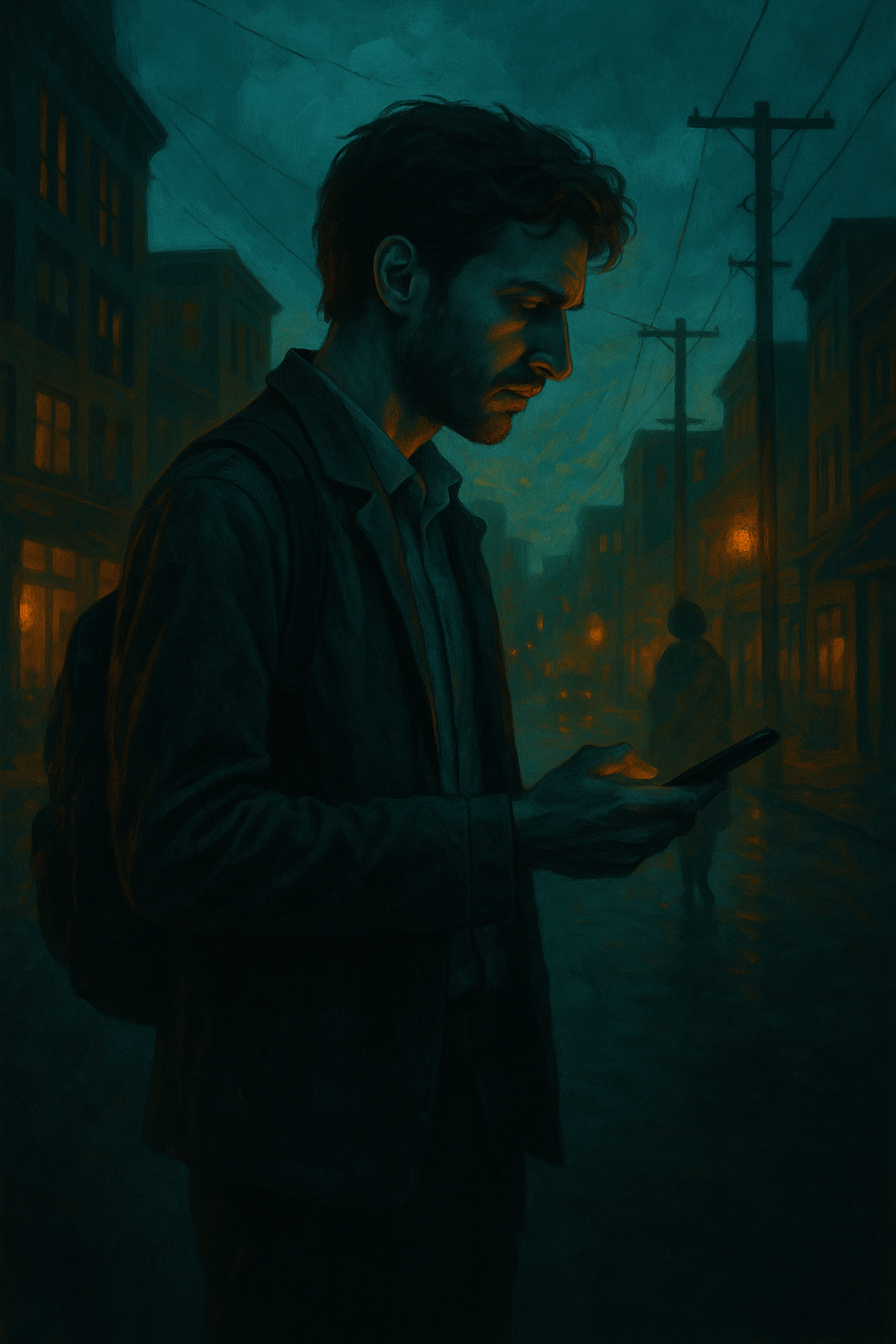
The Silent Sunrise
At 5:47 in the morning, Ben Mathers's phone began to stack notifications on the nightstand in the way snow accumulates on a windowsill. Silently. With persistence. With the assumption that no one is watching. He was watching. He had been awake since something like four. The grey light coming through the blinds was the precise color of the inside of an oyster shell, and the dust on the sill had organized itself into small drifts that suggested the window had not been opened in a season. Ben is thirty-four. He coordinates youth literacy programs for a non-profit in west Asheville. He has not, by his own count, had a conversation longer than nine minutes with another human being in the same room as him in eleven days. He counts these things. It's a habit he's developed the way some people develop a tremor.
The phone, face up, scrolled its quiet inventory. Three messages from Luna, sent between 11:14 and 11:52 the night before, each one shorter than the last. A reminder that his standing telehealth check-in had been auto-rescheduled. A digest from the office Slack, which had condensed sixty-two messages into a summary paragraph and a single recommended response, pre-typed, which he could send by tapping once. A wellness ping suggesting, gently, that his sleep score was trending downward and would he like to talk to someone. Someone, here, being a chatbot named Wren.
He did not tap Wren. He looked at the ceiling instead, which had a water stain shaped vaguely like the state of Florida, and he tried to remember the exact phrasing of the thing Luna had said to him on Tuesday night, in the kitchen, with her coat still on. He could remember her face. He could remember the angle of her jaw and the way she'd set her keys down on the counter with too much care, the way you set down something that might detonate. He could not remember the sentence. The sentence had been the kind of sentence that rearranges furniture in a person, and now he was living in the rearranged room and could not recall what had been moved.
He got up. He made coffee in the small French press because the pod machine had begun, last spring, to feel like a small humming companion he resented. He stood at the counter in his socks and drank it black and watched the street. Across the way, a woman was walking her dog with one hand and conducting what appeared to be a full business meeting through her earpiece with the other, her mouth moving steadily, her eyes on nothing in particular. The dog squatted. She did not look down. The dog finished and looked up at her with a kind of patient confusion Ben recognized.
He went to the closet for his coat, because he had decided, sometime between the third sip and the fourth, that he would walk to the office instead of taking the shuttle. Forty minutes on foot. Forty minutes of weather on his face. It felt, mildly, like an act of resistance, and he was aware that this was a low bar for resistance, and he was aware that he was grading himself on a curve. The card fell out of his coat pocket when he lifted it from the hook.
It landed face down on the hardwood with the small precise sound of cardstock, which is a sound you don't hear much anymore. He looked at it for a moment before he picked it up, because nothing in his life arrived on paper. Bills came as notifications. Birthday cards came as animations. Even the census, last year, had been an app. The card was the size of a playing card and the color of bone. He turned it over. The handwriting was in dark blue ink, in a hand that slanted slightly forward, the kind of hand that learned cursive from someone who cared whether you learned it. An address on Haywood. A date, which was Thursday. A time, which was 7 p.m. No name. No logo. No QR. No little italic line at the bottom about how to unsubscribe.
He read it twice. He turned it over again, as though something might have appeared on the back in the interval, and nothing had. He could not remember putting on this coat in any context where someone might have slipped a card into the pocket. He could not remember the last time he had worn it, even, which troubled him in a separate way. He set the card face down on the table next to the phone. The phone, sensing inattention, dimmed itself. The screen went from grey to charcoal to black. In the black he could see, faintly, his own reflection, and behind it the kitchen, and behind the kitchen the window, and through the window the woman with the dog, who was now standing perfectly still in the middle of the sidewalk, listening to something only she could hear.
The two objects sat on the table an inch apart in the half dark. The phone, sleeping. The card, face down. Whatever was on the card had not been written by an algorithm, and Ben understood this the way you understand a change in the weather, without needing to be told. "And cut there," the woman said. She said it without raising her voice. She was sitting in a folding chair on the far side of a long table cluttered with paper coffee cups and a laptop and a small stack of index cards held together with a binder clip. The overhead fluorescents, which had been dimmed to a kind of pre-dawn blue for the read-through, came up by degrees until the room was just a room again. Beige walls. A whiteboard with names and arrows on it. A window with the actual afternoon behind it.
The reader, a man in his fifties with reading glasses pushed up into his hair, set the pages down and rolled his shoulders. "It's good," the woman said. She was looking at her notes, not at him. "It's quiet. I want it quieter." She was the writer. Her name was Maren Cho and she had three more chapters due to the production team by Friday and a sister in Portland who had called twice that morning and a husband at home who had texted, an hour ago, just the word soon, which could have meant anything. She capped her pen. She uncapped it. She wrote, in the margin of page one, the word slower, and underlined it, and looked at the window, and thought about the drive home, and about what she still didn't know about the man she was writing, and about how she was going to find out.
She gathered the pages. The room waited.