← Back to overview

The Last Connection

9 chapters · ~48 min read

novella

In a society where human interactions are increasingly mediated by technology, a non-profit program coordinator discovers a hidden network of individuals who resist this digital isolation. As he delves deeper into their world, he must balance his own desire for connection with the demands of his professional life and the turbulent relationship with a driven friend.

Near-future Asheville, a city adapting to digital mediation in everyday life.

Chapter 1 · ~5 min read

The Silent Sunrise

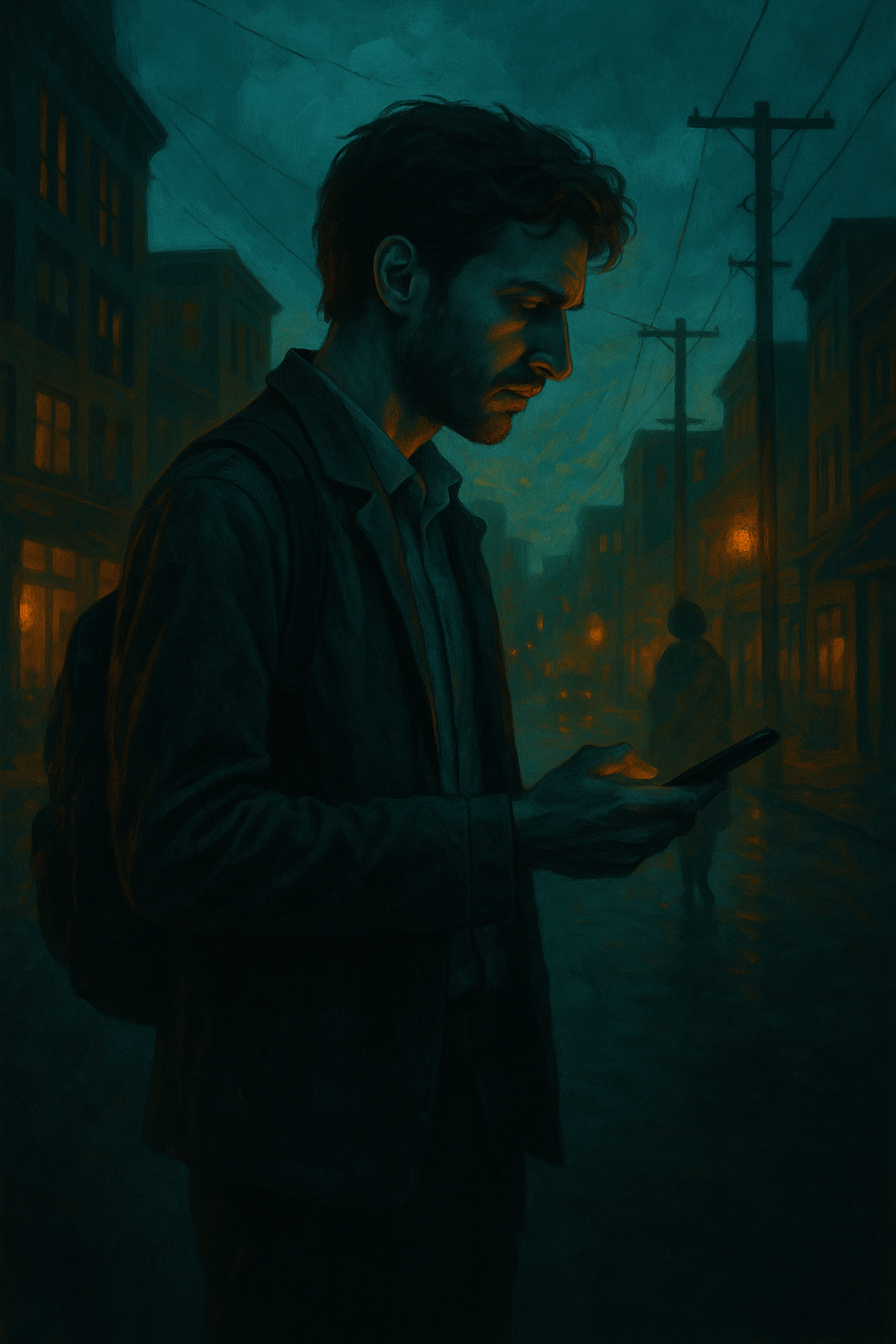
At 5:47 in the morning, Ben Mathers's phone began to stack notifications on the nightstand in the way snow accumulates on a windowsill. Silently. With persistence. With the assumption that no one is watching. He was watching. He had been awake since something like four. The grey light coming through the blinds was the precise color of the inside of an oyster shell, and the dust on the sill had organized itself into small drifts that suggested the window had not been opened in a season. Ben is thirty-four. He coordinates youth literacy programs for a non-profit in west Asheville. He has not, by his own count, had a conversation longer than nine minutes with another human being in the same room as him in eleven days. He counts these things. It's a habit he's developed the way some people develop a tremor.

“

He counts these things. It's a habit he's developed the way some people develop a tremor.

The phone, face up, scrolled its quiet inventory. Three messages from Luna, sent between 11:14 and 11:52 the night before, each one shorter than the last. A reminder that his standing telehealth check-in had been auto-rescheduled. A digest from the office Slack, which had condensed sixty-two messages into a summary paragraph and a single recommended response, pre-typed, which he could send by tapping once. A wellness ping suggesting, gently, that his sleep score was trending downward and would he like to talk to someone. Someone, here, being a chatbot named Wren.

He did not tap Wren. He looked at the ceiling instead, which had a water stain shaped vaguely like the state of Florida, and he tried to remember the exact phrasing of the thing Luna had said to him on Tuesday night, in the kitchen, with her coat still on. He could remember her face. He could remember the angle of her jaw and the way she'd set her keys down on the counter with too much care, the way you set down something that might detonate. He could not remember the sentence. The sentence had been the kind of sentence that rearranges furniture in a person, and now he was living in the rearranged room and could not recall what had been moved.

He got up. He made coffee in the small French press because the pod machine had begun, last spring, to feel like a small humming companion he resented. He stood at the counter in his socks and drank it black and watched the street. Across the way, a woman was walking her dog with one hand and conducting what appeared to be a full business meeting through her earpiece with the other, her mouth moving steadily, her eyes on nothing in particular. The dog squatted. She did not look down. The dog finished and looked up at her with a kind of patient confusion Ben recognized.

He went to the closet for his coat, because he had decided, sometime between the third sip and the fourth, that he would walk to the office instead of taking the shuttle. Forty minutes on foot. Forty minutes of weather on his face. It felt, mildly, like an act of resistance, and he was aware that this was a low bar for resistance, and he was aware that he was grading himself on a curve. The card fell out of his coat pocket when he lifted it from the hook.

It landed face down on the hardwood with the small precise sound of cardstock, which is a sound you don't hear much anymore. He looked at it for a moment before he picked it up, because nothing in his life arrived on paper. Bills came as notifications. Birthday cards came as animations. Even the census, last year, had been an app. The card was the size of a playing card and the color of bone. He turned it over. The handwriting was in dark blue ink, in a hand that slanted slightly forward, the kind of hand that learned cursive from someone who cared whether you learned it. An address on Haywood. A date, which was Thursday. A time, which was 7 p.m. No name. No logo. No QR. No little italic line at the bottom about how to unsubscribe.

He read it twice. He turned it over again, as though something might have appeared on the back in the interval, and nothing had. He could not remember putting on this coat in any context where someone might have slipped a card into the pocket. He could not remember the last time he had worn it, even, which troubled him in a separate way. He set the card face down on the table next to the phone. The phone, sensing inattention, dimmed itself. The screen went from grey to charcoal to black. In the black he could see, faintly, his own reflection, and behind it the kitchen, and behind the kitchen the window, and through the window the woman with the dog, who was now standing perfectly still in the middle of the sidewalk, listening to something only she could hear.

The two objects sat on the table an inch apart in the half dark. The phone, sleeping. The card, face down. Whatever was on the card had not been written by an algorithm, and Ben understood this the way you understand a change in the weather, without needing to be told. "And cut there," the woman said. She said it without raising her voice. She was sitting in a folding chair on the far side of a long table cluttered with paper coffee cups and a laptop and a small stack of index cards held together with a binder clip. The overhead fluorescents, which had been dimmed to a kind of pre-dawn blue for the read-through, came up by degrees until the room was just a room again. Beige walls. A whiteboard with names and arrows on it. A window with the actual afternoon behind it.

The reader, a man in his fifties with reading glasses pushed up into his hair, set the pages down and rolled his shoulders. "It's good," the woman said. She was looking at her notes, not at him. "It's quiet. I want it quieter." She was the writer. Her name was Maren Cho and she had three more chapters due to the production team by Friday and a sister in Portland who had called twice that morning and a husband at home who had texted, an hour ago, just the word soon, which could have meant anything. She capped her pen. She uncapped it. She wrote, in the margin of page one, the word slower, and underlined it, and looked at the window, and thought about the drive home, and about what she still didn't know about the man she was writing, and about how she was going to find out.

She gathered the pages. The room waited.

Next · Ch 2 →
An Unexpected Message
Chapter 2 · ~5 min read

An Unexpected Message

The phone buzzed at 9:14, then 9:14 again, then a third time at 9:14, because the system clock didn't care how many alerts arrived inside a single minute. Each one threw a soft white rectangle of light across the stack of grant folders on Ben's desk. The folders had been there since Monday. It was Thursday. The notifications were, in order: a calendar reminder, a thread reply, an automated wellness check from the building's air system asking him to rate the air quality in his cubicle from one to five stars, a Slack mention from someone whose name he didn't recognize, and a message from Luna that said only, on my way, three minutes. He turned the phone face-down. The buzzing continued through the glass, muffled, like an insect trying to remember what it had come into the room to do.

On the desk, half-hidden under a coffee-ringed printout of the quarterly metrics, was the envelope. Cream paper. No return address. Inside, a single card with an address on Lexington and a date and a time and one line beneath it. No phone. No camera. Come as you are. He had read the line eleven times since Tuesday. He had not photographed it, which, he was beginning to understand, was the point. To photograph it would be to file it, and to file it would be to make it searchable, and to make it searchable would be to undo whatever quiet, deliberate work had gone into sending a paper card to a man whose entire professional life ran on a dashboard. The instruction read, the second time, less like a quirk and more like a door closing softly behind him.

Luna arrived in two minutes, not three. She had been early to everything since college, and Ben had once found this charming, the way you find a friend's small ferocities charming when you're not yet downstream of them. She dropped her canvas bag onto the chair across from his desk. She did not sit. She slid her tablet over the printouts, over the coffee ring, and angled it so the screen faced him directly. The proposal filled the screen in the cool sans-serif that all proposals wore now. PRESENCE, it said, in letters tall enough to be a verb. Below: a pilot program for emotionally-augmented digital companionship in underserved populations. A budget. A timeline. Her name on the byline, and beneath her name, in smaller letters, a question mark where his name should have been. "I need you present, Ben," she said.

“

To photograph it would be to file it, and to file it would be to make it searchable, and to make it searchable would be to undo whatever quiet, deliberate work had gone into sending a paper card to a man whose entire professional life ran on a dashboard.

He looked up at her. She was already half-turned toward the window, scrolling something on her phone with her thumb, her other hand pulling her hair back. Present, he understood, did not mean here. Present meant signed on. Present meant attached. Present meant available to her timeline, her grant cycle, her ambition, which was not a mood she was in but a weather system she lived inside and expected him to live inside too. "This is a lot," he said. "It's the next thing." "It's always the next thing." She finally looked at him. Luna had a way of looking at people that made them feel briefly diagnosed. She had been like this at twenty-two and she was like this at thirty-one, and the only thing that had changed was that the world had built more rooms for her to walk into and be the most prepared person in.

"Ben. We had this conversation." They had not had this conversation. They had had a different conversation, last week, in which he had said something soft about missing her and she had heard something else, something accusatory, and the night had gone sideways. He let it stand. He let her keep the version where they had already covered it. "I just want to talk," he said. "Not about the project. About. You know." "About what."

He could feel the card in the drawer beneath his hand. He could feel the shape of the room he had not yet walked into, the address on Lexington, the people who had decided that the way to reach him was to write to him on paper. He could not say any of it. To say it would be to admit that he was already looking for a door out of the room she was building, and she would hear that, and she would be right to hear that, and the conversation would end before it began. "Forget it," he said.

She held his eyes for one more second, long enough for him to understand that she had registered the swerve and chosen not to chase it. Then she tapped the tablet twice, which sent the proposal to his inbox, which made the phone on his desk buzz again, face-down, against the wood. "Read it tonight," she said. "I need an answer by Friday." She was at the door before he had decided what his face was doing. She didn't say goodbye. Luna didn't say goodbye in offices. She said it in restaurants and on sidewalks and once, memorably, in a hospital, but offices were transit, and you didn't farewell transit.

“

Present meant signed on. Present meant attached. Present meant available to her timeline, her grant cycle, her ambition, which was not a mood she was in but a weather system she lived inside and expected him to live inside too.

He looked back at the tablet. The screen, untouched for thirty seconds, began to dim. The letters of PRESENCE softened, grayed, faded. And then the screen went fully black, and in the black glass he could see her, ghosted, her shoulder, the back of her head, already gone, and behind her the empty chair, and behind the chair the door she had not bothered to close. And then a voice said, gently, from somewhere above and to the left, "Cut."

The light in the room shifted. Not metaphorically. A bank of softboxes overhead clicked down two stops, and the walls of Ben's office, which had looked, a moment ago, like drywall, revealed themselves as flats on wheels. A woman with a clipboard stepped past the camera and said something quiet to the actor playing Ben, who nodded and reached for a water bottle that had been waiting just out of frame. Maya, in row four of the small screening room where the dailies were being reviewed, uncrossed her legs and made a note on her tablet. The note said: works. keep the dim. She had three more scenes to get through before her daughter's pickup at six, and her ex-husband had already texted twice about the handoff, and she had not yet decided whether to answer.

She looked at the frozen frame on the monitor. The black tablet. The ghost of the actress in the glass. The empty chair. She thought, briefly, of her own office, and of the cream envelope that had arrived at her apartment on Tuesday, which she had not yet opened, and which was sitting on her kitchen counter under a bowl of clementines, waiting. She closed the tablet. "Next," she said.

← Previous · Ch 1
The Silent Sunrise
Next · Ch 3 →
Café Rendezvous
Chapter 3 · ~5 min read

Café Rendezvous

The café smells of cardamom and old wood, and every table is occupied by people talking. Actually talking. Their voices layer into a sound Ben can't immediately parse, because he so rarely hears it in a room this size, without the soft underlayer of devices chiming, without anyone glancing down mid-sentence. It takes him a beat to recognize what's missing. The hush of attention elsewhere. The phones. The place is called Vesper, tucked behind a bicycle repair shop off Lexington, and the front window has been papered over from the inside with old concert flyers. A handwritten sign on the door reads CLOSED FOR PRIVATE EVENT. Ben had stood outside for ninety seconds before going in, his thumb pressing the corner of the invitation card in his pocket until it softened.

“

It takes him a beat to recognize what's missing. The hush of attention elsewhere. The phones.

A man at the counter nods at him. Doesn't ask his name. Points to a back room separated by a curtain of strung wooden beads, and Ben, who works in a building where every door requires a badge, finds himself disarmed by the simplicity of being waved through. The back room holds maybe fourteen people. A long table, mismatched chairs, two pots of tea wrapped in dish towels to keep them warm. There is a small wooden bowl at the center of the table, and as Ben watches, a man in a flannel shirt walks in, removes his phone from his pocket, powers it down, and sets it in the bowl. He does this with the absent ease of someone hanging a coat on a hook he's used a thousand times. The bowl already holds five or six phones, stacked like river stones.

No one tells Ben to do it. They watch him notice. He fishes his out, holds the power button until the screen goes black, and adds it to the bowl. A woman across the table exhales, very slightly, as if a small test has been passed. She is maybe sixty. Gray hair cropped close. Reading glasses on a chain. She introduces herself as Iris and gestures to the empty chair beside her, and Ben sits.

The others go around. A nurse from Mission Hospital named Dev, who says he started coming because he realized he hadn't touched another human being outside of work in four months and it was making him a worse nurse. A retired postal carrier named Margaret with hands like worn leather. A young man in a Carhartt jacket who teaches eighth-grade history and says, simply, that his students don't know how to have arguments anymore, only how to mute each other. A woman named Sofia who runs a daycare and says her three-year-olds are starting to swipe at picture books.

None of them look like radicals. That's the thing Ben keeps noticing. He had pictured, on the walk over, some configuration of hooded conspirators, or else the kind of brittle utopians who buy land in Vermont. These are people who could be in line behind him at the co-op. A nurse. A teacher. A grandmother. The ordinary middle of a city, gathered in a back room because the ordinary middle of a city has become a thing you have to gather in a back room to find.

When it's his turn, Ben says his name and stops. The silence that follows is patient, not predatory. He says he isn't sure why he's here. He says he opened an envelope and it felt like the first piece of mail anyone had sent him in years that wasn't trying to sell him something or measure him. Margaret laughs, a single quiet sound, and says, that's because it wasn't.

They talk for a while about nothing in particular. The way Dev's mother died over a video call and how the hospice nurse had to hold the tablet at the right angle. The way Sofia's husband had started narrating their dinners aloud as if for an audience that wasn't there. Small testimonies, offered without performance. Ben realizes after twenty minutes that no one has checked the time. There is no time to check. The clock on the wall is analog and ten minutes slow and no one cares. Then Iris reaches under her chair and brings up a ledger.

“

None of them look like radicals.

It is cloth-bound, the color of dried moss, and the spine has been repaired with what looks like dental floss. She sets it on the table in front of her and opens it, and Ben sees columns. Dates. First names. A small mark beside each, some symbol he can't read. The earliest date on the visible page is from nine years ago. She turns the book and slides it across to him. She doesn't say anything. She folds her hands in her lap and waits.

Ben understands, without being told, that this is the question. Whether he will touch it. Whether he will put his name in it. He also understands, with a clarity that arrives before he can argue with it, that Iris knows where he works. The lanyard he forgot to take off this morning is still looped through his belt. NorthStar Mediation Services. The logo small but legible. He had noticed her noticing it when he sat down. He thinks about Luna, briefly, and then doesn't. He thinks about the fact that he has not been touched, in the casual passing way of a hand on a shoulder, in three weeks. He thinks about the bowl of phones. He thinks about what it would mean to walk out of this room having seen this and been told, gently, that he isn't the kind of person they can know.

He puts his hand flat on the open page. Not to sign yet. Just to rest it there. To say, I am still here. I am still deciding, but I am still here. Iris watches his hand. The room keeps talking around them, the murmur thickening, a laugh rising from the far end of the table. Somewhere under his jacket, draped over the back of the chair, his phone is dark and silent and forgotten, and for the first time in longer than he can remember, Ben is not the one being watched. Cut.

The word comes from a woman in a headset standing just beyond the lip of the table, holding a clipboard against her chest. The café noise drops out as if a fader has been pulled. A boom mic retracts upward into the rafters. Iris, who is not Iris, reaches for a water bottle a production assistant is already extending toward her, and asks if they got the hand.

In a darkened room two floors above the soundstage, a woman named Elena Ruiz pauses the monitor feed and writes a single word on the legal pad in her lap. Promising. Her own phone, face up on the arm of the chair, lights with a message from her daughter asking if she's coming to dinner. She turns it over without reading past the preview. She has another two hours of footage to get through tonight, and a note to send to the writers about whether the ledger is landing too early, and a husband at home who has stopped asking when she'll be back. She rewinds the scene to the moment the hand touches the page, and watches it again.

← Previous · Ch 2
An Unexpected Message
Next · Ch 4 →
The Code Breakers
Chapter 4 · ~6 min read

The Code Breakers

The map was taped to the inside of the bathroom door at chest height, just below the hook where you'd hang a coat if anyone in this café still wore one. Pencil. Six neighborhoods sketched freehand, the French Broad rendered as a wobbling ribbon, and small open circles inked over the streets like buckshot. West Asheville. Montford. Kenilworth. A cluster in Oakley dense enough to be a constellation. Beside each circle, a date. Ben stood in front of it longer than the situation required, his hand still on the lock, and counted twenty-three circles before he stopped counting.

When he came back out, Mira had set a fourth chair at the table and was pouring something the color of weak tea into mismatched cups. There were five of them now, including him. He'd met two of them before, the woman with the cropped gray hair who called herself Pell, and the man in the canvas apron who ran the café and seemed to think of himself less as a host than as a kind of weather. The two others, a tall woman named Devi and a quiet kid in his twenties who hadn't said his name, were new. "You found the map," Mira said. It wasn't a question. "I saw your face when you came back." "Twenty-three meetings," Ben said. "Twenty-six. Three weren't worth circling."

The café man, whose name was Aubrey, set down the pot and pulled up the fourth chair for himself. He had the patient hands of someone who'd spent a long time pouring things. "We started in Pell's living room," he said. "Eight people. Now it's any room that holds us. We don't post. We don't text the list. Someone walks to someone else's house and knocks." "Knocking," Devi added, "being a kind of lost art."

It is worth pausing here to note that Ben Ashford, thirty-four, program coordinator at a regional non-profit whose mission statement contained the phrase fostering authentic community in a mediated age, had spent the better part of three years writing grants for software. Apps that nudged people toward in-person events. Platforms that matched volunteers with neighbors. He had, in the last fiscal quarter alone, helped allocate four hundred thousand dollars to digital tools designed to do, badly, what these four people were doing in a back room with a hand-drawn map and a kettle. He hadn't put it together yet. He was still on the kettle. "How do new people find you," he asked.

“

Someone walks to someone else's house and knocks.

Pell smiled in a way that wasn't quite a smile. "They don't, mostly. We find them. Someone notices someone sitting alone too long in the same place. Someone overhears the right kind of complaint. It's slow. It's supposed to be slow." "We had a faster version once," Aubrey said. "It didn't end well." They did not elaborate, and Ben, who had been trained by years of nonprofit board meetings to fill silences with himself, filled this one. He told them about his job. He told them about the metrics, about the dashboards, about the way his director used the word ecosystem. He told them, because the warmth of the room had begun to do something to his caution, about Luna.

"She works ninety-hour weeks," he heard himself say. "She's building something, an analytics thing, the details don't matter, what matters is she hasn't eaten across from another person in I don't know how long. She sleeps with her phone face-up. She's started, lately, looking at me like I'm a window she's about to close. She's the most ambitious person I know and I think she's, I don't know what the word is, I think she's." He trailed off because he had clocked, halfway through the sentence, that the nodding around the table was not the nodding of people listening to a man describe his difficult friend. It was the nodding of people recognizing someone. Pell was looking at him with the particular patience you use on a person who has just described the symptoms of a disease he doesn't know he has.

"That's who we're for," Devi said quietly. "Your friend. Not you." Ben set his cup down. He had come here, he understood now, with a pitch in his back pocket. He'd been polishing it on the walk over without admitting it to himself. Some version of: let me bring this into the org, let me find you funding, let me give you infrastructure. He had imagined himself as the bridge. The translator. The good institutional actor who knew, finally, where the real work was happening and could route resources toward it. And the people at this table had spent however many years building something whose entire integrity depended on not being routed toward. On not being found by the dashboards. On the slowness being the point. He was, from where they sat, exactly the kind of well-meaning visitor they had reasons, plural, to be wary of.

He didn't say any of this. He drank the tea, which was bitter and good, and asked instead about the circles in Oakley, and Aubrey talked about a retired bus driver who'd hosted four gatherings in his garage, and Ben listened, and underneath the listening a quieter mechanism was turning over, the recognition that the work he did for a living and the work being done in this room might be, in some essential way, opposed. When he stood to leave an hour later, Pell walked him to the door. She had the map in her hand. She had taken it down from the bathroom without his seeing. "Take it," she said. "I shouldn't." "It's a copy. We make copies. Take it and look at it tonight and then decide if you want to come back."

He folded it into quarters and slid it into the inside pocket of his jacket, against his chest, where it sat as a soft rectangle just over his sternum. Outside, the evening had gone the particular blue Asheville goes in October, mountains darker than the sky, the streetlights not yet committed. He walked east. The map shifted with his breathing. He could feel each of its folded edges. "And. Hold there." The voice came from somewhere behind the camera, calm, almost bored. A woman's voice, mid-fifties, the kind of voice that had said this exact word ten thousand times. "Cut. Reset to his exit. Sound, we're getting the fridge again, can someone kill the fridge."

The sidewalk was a sidewalk for another half second and then it was a sidewalk built on a soundstage in Burbank, and the mountains behind it were a print, and the blue of the sky was a gel over a light the size of a small car. A young man in a headset crossed the frame carrying a coiled cable. Someone laughed, off to the left, at something unrelated.

The director, whose name was Joanne Reyes and who had three weeks left on this shoot and a daughter in her second year at Reed who hadn't returned her last two calls, lowered her clipboard and rubbed the bridge of her nose. She watched the actor playing Ben unfold the prop map and hand it back to the prop assistant, who would re-fold it for the next take along the exact same creases. Joanne had asked for those creases specifically. She wanted them sharp.

She was thinking about the call. Not the scene, the call. Her daughter had left a voicemail at two in the morning, three words long, I'm okay mom, and Joanne had listened to it four times on the drive in and could not decide whether it was a message or an answer to a question she hadn't asked yet. She'd try her again at lunch. She'd try her again at lunch and if she didn't pick up, Joanne would, she didn't know what she would do. She would do the next take first. She would do the next take and then she would try her again at lunch. "Going again," she said, louder, to the room. "From the door. Map in the pocket. Same blue."

← Previous · Ch 3
Café Rendezvous
Next · Ch 5 →
Choices at Dusk
Chapter 5 · ~6 min read

Choices at Dusk

The overhead lights on the east half of the floor had been off since four. The building called it a load-shedding protocol. Everyone called it the dimming. Ben sat in the surviving glow of his monitor, the blue rectangle of it the brightest thing in the room, and watched a spreadsheet refuse to balance. He had been at the non-profit for six years. Long enough to know which line items the board protected and which they pretended to. Long enough to know that community outreach, the line he ran, was always the one circled in red when the quarter turned ugly. He had learned to write grant language in his sleep. He had learned that the word engagement, attached to almost anything, could keep a program alive for another six months.

The office at this hour was mostly empty. A custodian moved through the far row with a soft cart. Two of his colleagues sat at their desks in their own pools of light, headphones on, faces tilted up into whatever the screen was giving them. The HVAC ticked. Outside, the mountains were doing what mountains do at dusk, which is to say nothing, gorgeously.

The meeting in twenty minutes was about reallocation. He had been over the agenda four times. There was a proposal on the table to fold three small in-person programs into a single platform contract. A single vendor, a single login, a unified metrics dashboard. The pitch was efficient. The pitch was beautiful, in the way that a clean room is beautiful. It would also require him to move two community partner sites onto the platform. One of those sites was a building on Depot Street that, in the evenings, ran on no platform at all. A building where people sat in folding chairs and looked at each other and said their own names out loud.

Luna had championed the reallocation. She had built the deck. She had spent two weeks on the metrics framework and had, in the kitchen last Thursday, told him, with the particular brightness she got when she was certain, that this was how you scaled care. You instrumented it. You made it legible. You stopped losing people in the gap between intentions and outcomes. She had looked at him while she said this in a way that suggested she had noticed he was somewhere else, lately, and was waiting for him to come back. He loved her. That was not the problem. The problem was that she was right about almost everything and wrong about the one thing he could not yet say.

“

The problem was that she was right about almost everything and wrong about the one thing he could not yet say.

His supervisor, Marin, came down the row at five of, in the soft shoes she wore on long days, and set a single printed page on his desk. She did this sometimes. She believed in paper for difficult conversations. The page was the budget sheet. The community outreach line was circled in red ballpoint, the kind of red that meant a decision had been made elsewhere and was now being shown to him as a courtesy. "Read it before we go in," Marin said. "I want you with me on this." She didn't wait for an answer. She moved on toward the conference room, her shoes making almost no sound on the carpet.

Ben read it. He read it again. The number under the red circle was the number that paid the part-time facilitator at the Depot Street site. Without that line, the site went onto the platform by default, because the platform was free, and free was the only argument that ever won a Tuesday afternoon.

He picked up the desk phone. He held it for a moment against his ear and listened to the dial tone, which was a sound he was old enough to find consoling. He had Luna's number in his hand before he had decided to dial it. He could call her now, in the four minutes before the meeting, and tell her. Not everything. Just enough. He could ask her to pull the Depot Street site out of the proposal. He could give her a reason she would accept, something about a partner relationship, something about a grant restriction he would invent on the walk to the conference room. She would say yes. She trusted him in the small ways even when she was suspicious of him in the large ones. That was the shape of them.

He held the phone. He watched the cursor on his monitor blink inside the cell he had not finished filling. He thought about what it would mean to ask her to undo her own work without telling her why, and what it would mean, later, when she found out why, as she would, because she always did. He thought about the folding chairs. He thought about the woman at Depot Street who had said, the first night he sat in, that she came because it was the only hour of her week that nobody was counting her. He set the phone back down.

He told himself he would speak in the meeting. He told himself he would find a way to raise the Depot Street site without naming it, to suggest a carve-out, a pilot exemption, language the board liked. He told himself a great many useful things in the thirty seconds it took to stand up and gather the page. In the conference room, under the only fully lit ceiling on the floor, Luna was already at the table with her laptop open and her hair pulled back in the way she pulled it back when she intended to win. She looked up when he came in. She smiled, briefly, the smile of someone making a note.

He sat down across from her. Marin opened the meeting. The proposal went around the table. When it came to him, when Marin said, "Ben, anything from outreach," he opened his mouth, and what came out was the sentence he had rehearsed on the walk over, which was not the sentence about Depot Street. It was a smaller sentence. A sentence about timelines. A sentence that bought a week and cost nothing and committed to nothing and left the red circle exactly where it was. Luna nodded at him across the table, pleased. The proposal moved forward. He sat through the rest of the meeting with his hands flat on the page in his lap so they would not do anything he had not authorized them to do. "Cut," the director said. "Hold there."

“

He thought about the woman at Depot Street who had said, the first night he sat in, that she came because it was the only hour of her week that nobody was counting her.

The overhead floods on the soundstage rose by half a stop. The conference room, it turned out, had no fourth wall. The mountains outside the window were a printed scrim, lit from behind, and a grip was already walking toward it with a ladder. In the monitor village at the back of the stage, a woman in a cardigan, mid-fifties, with reading glasses pushed up into her hair, watched the playback of Ben setting the phone down. She watched it twice. She made a small mark in the margin of her script with a pencil she had been chewing. "He should call," the script supervisor said, beside her. "He doesn't," the woman said. "That's the whole episode."

She stood. Her knees made the sound knees make after ten hours in a folding chair. Her phone, face-down on the console, had been buzzing for the last twenty minutes, and she had been pretending not to notice, and now she turned it over and looked at the screen. Three missed calls from her daughter. One voicemail. A text that said only, when you can. She put the script down on the console, picture-side up, the red circle on the budget page still visible under the prop monitor's blue glow, and she walked out toward the parking lot to find a quiet place to call her back.

← Previous · Ch 4
The Code Breakers
Next · Ch 6 →
The Broken Screen
Chapter 6 · ~6 min read

The Broken Screen

The phone landed face-up on the kitchen table with the small definite sound of a thing being entered into evidence. Luna didn't take her hand off it right away. She let it sit under the lamp, and the lamp caught the cracks in the screen so they looked like a river system, all the tributaries leading nowhere. "It's been like that since Tuesday," she said. "I dropped it running for a meeting you didn't come to." Ben sat down across from her, because not sitting felt worse. He'd cooked. There was a pot of something on the stove that had stopped being food about an hour ago, when he'd realized she was actually coming and actually angry. Luna had been to this apartment maybe sixty times in eight years. She knew where the bowls were. She wasn't getting one. "I texted," he said.

"You texted at four fifty-three for a five o'clock meeting that I drove across town to host. For your organization. As a favor." "I know." "Do you." The refrigerator was quiet. The apartment was quiet. Outside, somewhere down Haywood, a delivery drone made the soft insect sound they all made now, and then didn't. Luna was wearing the blazer she wore when she wanted to be taken seriously, which meant she'd come here straight from something or was going somewhere after, and either way Ben was a stop on a route. She'd been like this since college. She booked her grief in fifteen-minute increments. He used to find it funny. "Where are you, Ben." "I'm here." "You're not. You haven't been. For weeks. And before you say work, don't, because I know what your work looks like and this isn't it."

He could feel the shape of the thing he wanted to say. The room above the laundromat. The way Maya had laughed at something he said and it had landed in him like a coin dropping into a deep well, and he'd realized he hadn't heard that sound, that specific sound of being heard, in a year. Maybe two. Maybe since Luna had taken the job at Sequoia and started answering his messages in bullet points. He could say: I found a room where people put their phones in a basket. He could say: it reminded me of us, before. He could say: I think I've been lonely with you for a long time and I didn't have a word for it until I sat in a room full of strangers and felt less lonely than I do at your birthday parties.

He said, "There's a group I've been spending time with." Her face did something small and terrible. Not surprise. Recognition. "A group." "People who. Meet. Without devices. It's not a cult, it's not." "I didn't say cult." "I know you didn't." "I said group. I'm letting you tell me what it is." She had not picked up the phone. She had not moved her hand. "Go ahead." And this was the moment. He understood it as it was happening, which was rare for him. He had a clear shot at the truth and a clear shot at the lie and the truth would cost more, so he aimed for somewhere between. "It's helped me think," he said. "About. How I want to spend my time. Who I want to spend it with." "And I'm not on the list." "That's not."

"You were easier to reach before you started disappearing in person." The refrigerator cycled on. Ben heard it the way you hear a verdict. He didn't have anything. He sat in the kitchen he'd lived in for six years across from the person who'd helped him move into it, and he had nothing to say, and the compressor hummed, and Luna watched him not say it, and something in her face went from hot to cold in the way that meant she had already left and was waiting for her body to catch up. "You think I don't know," she said, quieter. "You think I picked the job and the calendar and the. The whole apparatus. Because I wanted it." "I didn't say."

"I picked it because if I'm useful, people keep me. That's it. That's the whole strategy. I'm not complicated, Ben, I'm just scared in a direction you find inconvenient." He looked at her. He had known her since she was nineteen and had a stick-and-poke of a moth on her ankle that she'd done herself in a dorm bathroom. He had not known this. Or he had known it and not let himself, which was worse. "Luna." "You disappear and I work harder. That's the trade. That's always been the trade. And I was fine with it when I thought you were disappearing into your job, because at least we were both running from the same thing. But you're not. You found something. You found people. And you didn't tell me, because you knew I'd hear it as." She stopped. Her throat worked. "As what it is."

"It's not a replacement." "Then why didn't you bring me." He opened his mouth. He had thought about it. Twice. Three times. He had pictured Luna at the top of those stairs with her phone in her hand and her calendar open and the soft, particular way she would have made everyone in that room feel like an item on an agenda, and he had decided, without deciding, that he wanted the room more than he wanted her in it. She watched him not answer. She stood up. She left the phone on the table. She did it on purpose. He saw her decide to do it. "Keep it," she said. "It's broken anyway."

“

She booked her grief in fifteen-minute increments.

The door didn't slam. Luna had never slammed a door in her life. She closed it with the same competence she closed everything, and her steps went down the hall, and the elevator chimed, and Ben sat at the table with a pot of cold food and a phone that wasn't his. He picked up his own phone. He called her. It rang once on the table in front of him before he understood, and then it rang on her end too, somewhere in the elevator or the lobby or the street, and it rang, and it rang, and the cracked screen on his table lit up with his own name in jagged blue light, and he watched it ring itself out. "Cut."

The word came from somewhere behind the refrigerator, which was not a refrigerator. A woman in a charcoal cardigan stepped past the kitchen island holding a tablet, and the kitchen island slid two inches on its casters, and the lamp above the table went from warm to flat as someone killed the practical and brought up the work lights. "Reset to the phone landing. We're going again." The actor playing Ben exhaled and rolled his neck. Somebody handed him a water. The director, whose name was Priya and who had three missed calls from her daughter's school stacked on the tablet in her hand, did not look at the monitor. She was looking at the prop phone on the table, the cracked one, and thinking that the crack pattern read too pretty, too deliberate, and they'd need to redress it before the next take.

Her daughter had fallen on the playground. It wasn't serious. The school had called, and called again, and then called the emergency contact, who was Priya's ex-husband, who lived twelve minutes from the school and had picked her up forty minutes ago. Priya knew this because she had finally checked her phone between setups. She had not called back yet. She was going to. She was going to call as soon as they got this take, because the light was going, and they only had the kitchen until ten, and her daughter was fine, her daughter was with her father, her daughter was fine. "Places," Priya said. She set the tablet down, screen up, on the apple box beside her chair. A notification bloomed across it and faded. She didn't look.

← Previous · Ch 5
Choices at Dusk
Next · Ch 7 →
Signal Loss
Chapter 7 · ~5 min read

Signal Loss

The bench was cold through his jeans in a way that suggested it had been cold all morning and intended to stay that way. Ben sat at the north end of Pritchard Park with his messenger bag between his feet and watched a woman in a teal jacket try, three separate times, to hail a rideshare that kept declining her before it arrived. She wasn't angry about it. She just kept tapping, the way you'd tap a vending machine. Around her, the city did its quiet Tuesday choreography. A man delivering bread to the café on the corner. Two kids in matching school polos pulling a wagon full of, improbably, sheet music. The buskers hadn't set up yet. The drum circle wouldn't start until sundown.

He was supposed to be at the office. He had told Marguerite, his supervisor, who had hired him at twenty-six and given him the corner cubicle and once described him to a board member as "reliable in the way water is reliable," that he had a dentist appointment. He did not have a dentist appointment. He had walked out the side door at nine-fifteen with his coat half on and gotten as far as this bench before he stopped knowing where he was going.

The text from Devon had come in at eight forty-two. Three lines. Devon was leaving. Taking the contact lists, taking the meeting calendar, taking the spreadsheet of safe houses that wasn't called a spreadsheet of safe houses but functionally was. Devon, who had built the group's whole nervous system. Devon, who Luna had vouched for Ben to. Devon, who had said to Ben at the second meeting, you have a face that listens, which Ben had taken as a compliment and then later, in the shower, realized might not have been one. Without Devon, there was no Thursday. Without Thursday, there was nothing for Ben to have risked anything for. He watched a pigeon investigate a coffee cup lid. The pigeon was methodical. It had a system.

What surprised him, sitting there, was that he wasn't thinking about Luna. He had expected to be thinking about Luna. He had spent the better part of three nights running their last conversation in his head, the way she had said your job is the problem and he had said my job is what makes any of this possible and neither of them had been wrong and that had been the worst part. He had expected her to be the loudest thing in his head this morning. She wasn't. What was loudest was a memory of the fourth meeting, two months ago now, when an older man named Sal had brought a thermos of soup to share and they had passed it around with one spoon and Ben had felt, briefly and without warning, his shoulders drop. Not relax. Drop. As if they had been held up by wires he hadn't known about until the wires went slack.

He had spent, he understood now, a great deal of his life managing the distance between himself and other people. Calibrating it. Adjusting the dial. He was good at his job because his job was, essentially, professionalized calibration. He wrote grant reports about communities. He attended communities the way a hydrologist attends a river. The soup had not required calibration. The soup had just been soup.

He reached into his breast pocket for the folded paper Devon had given him six weeks ago, a photocopy of a hand-drawn map of the city with pencil circles marking what Devon had called nodes, places where the network gathered or had gathered or might gather, depending on the week. Ben had carried it without looking at it because looking at it at work felt like a security breach and looking at it at home felt like homework. He smoothed it on his knee now and the wind tried to take it and he held it down with his thumb. The circle nearest his thumb was Pritchard Park.

“

He had spent, he understood now, a great deal of his life managing the distance between himself and other people.

He had not chosen this bench. He had walked here. He had walked here without thinking about it and sat down because his legs had stopped, and the circle on the map was right where he was sitting, and it was possible, he thought, that he had been walking toward this bench for longer than he knew. A gust lifted the corner of the map again. He pressed it flat. Three pigeons landed near his shoe, considered him, and lifted off together when a bus exhaled at the curb. He watched them go. He did not move. The map stayed open on his knee, the pencil circles faint as breath on glass, and he sat with it the way you sit with news you haven't decided yet how to carry. "And cut."

The voice came from somewhere behind the camera that Ben, who was not Ben, could not see because of the angle of the light. He blinked. The bench was still cold. The pigeons were a sound designer's loop. "Reset to one. Lose the second bus, it's stepping on the line." A woman with a headset crossed the frame holding a clipboard against her chest like a shield, and the actor playing Ben unfolded his legs and stood and stretched the small of his back and accepted a paper cup of coffee from someone whose entire job was the coffee. The map went into a labeled ziplock. Pritchard Park, which was not Pritchard Park but a soundstage in a converted warehouse off Riverside, hummed back to life as crew.

In the monitor village, twelve feet from the bench, Hannah Yu watched the playback on a small screen with her arms folded and her mouth doing the thing her husband had once described as the thinking frown, which she had told him was just her face. She was the writer. She had been on set every day of this episode because the network had notes about Ben and she did not trust anyone else to defend him. Her phone buzzed on the producer's table. Daycare. Third time today. She let it go to voicemail and watched the actor sit back down on the bench and arrange his bag at his feet and become, again, a man who had walked somewhere without choosing to.

She would call daycare back in ten minutes. She would. The scene wasn't right yet. The map needed to land softer. The pigeons needed to leave first, and then the wind, and then him.

← Previous · Ch 6
The Broken Screen
Next · Ch 8 →
Building Bridges
Chapter 8 · ~5 min read

Building Bridges

The cardamom café on Lexington still wrote orders on the cup in pencil, which was the kind of detail Ben used to find precious and now just found accurate. He ordered two oat milk lattes, one with the half-spoon of honey Luna pretended she didn't want, and walked the eleven blocks to her apartment carrying them in a pressed-cardboard tray that grew warm and slightly damp against his palm. He did not text ahead. He had spent two years texting ahead. The phone in his pocket was on, but he had stopped treating it as a permission slip somewhere between the third block and the fourth.

“

He had spent two years texting ahead.

Luna lived on the second floor of a converted craftsman that the landlord had subdivided in the bright, brutal way landlords do. Her buzzer had been broken since March. Ben knew the trick: lean on the door, the latch gave. He climbed the stairs slowly so the coffees wouldn't slosh. He had rehearsed nothing. That was the point, or part of it. The other part was that he knew, with the specificity of someone who had been her friend for six years, that there was a manila folder on her kitchen table with his name on the tab, and inside it a draft of a complaint to the non-profit's board about misallocated hours and unauthorized use of program resources. She had told him she was writing it. She had not told him she was finished. He knocked.

There was a pause long enough that he counted the floorboards visible through the gap under her door. Three. Then footsteps. Then the click of the deadbolt, which she always threw even in the middle of the afternoon, a habit from a city she hadn't lived in for nine years. Luna opened the door in sock feet and a sweatshirt he recognized from undergrad. Her hair was up. Her face did the thing it does when she is preparing to be reasonable, the small tightening at the corners of the mouth that she probably believed was invisible. She looked at him. She looked at the cups. She looked, for a fraction of a second, past him at the hallway, as if checking whether he had brought anyone else, anyone from the group, anyone with a clipboard or a cause. He hadn't. She stepped aside.

She didn't say come in. She didn't say what are you doing here. She moved her body four inches to the left and let him pass, and Ben understood, walking past her into the small warm room that smelled like her shampoo and old coffee, that this was the first thing they had agreed on without negotiation since June. The folder was on the table. He saw it. She saw him see it. Neither of them said anything about it, which was its own kind of saying.

He set the cups down on the counter and then picked them up again, because the counter felt like a stage. He carried them across the room to the window, the big one that looked out over the parking lot and, past it, the ridge. He put both cups on the sill. He sat down on the floor underneath the window, his back against the radiator, which was cold because it was October and the building hadn't turned the heat on yet. After a moment, Luna sat down next to him. Not across from him. Next to. Their shoulders did not touch, but they were in the same weather.

He told her about the group. He had told her about the group before, but the previous tellings had been performances, little curated tours where he was the guide and she was the skeptic and the script was already written. This time he told her what it actually felt like to sit in Marta's living room with the phones in the bowl and not know what to do with his hands. He told her about the woman who had cried about her sister and how he had not, in the moment, thought of anything clever. He told her he had been using non-profit hours to be there. He said the word using. He didn't soften it.

Luna listened. She did the thing where she pulls a thread out of her sweatshirt cuff and winds it around her finger until the fingertip goes white, and then unwinds it. She did this four times. Ben counted because he needed something to do with the part of his brain that wanted to fill her silence. He asked her to come. Once. To one gathering. Not as a convert, not as an auditor, just as a person in a room. He said he wasn't asking her to like it. He said he wasn't asking her to not file the thing on the table. He said he was asking her to see the thing he had been failing to describe, and then she could decide what to do with all of it, including him.

She didn't answer. She got up. She went to the kitchen. Ben listened to her open a drawer and close it, open another, close it. She came back with two spoons, which made no sense for lattes, and handed him one anyway. She sat down again. She said, I'll think about it. It was not yes. It was the first sentence in nine weeks that hadn't been built like a wall. They sat there. The coffees cooled on the sill above their heads, steam unspooling into the cold pane. Outside, someone was trying to parallel park very badly. Luna started talking about something else, her sister's wedding, the caterer, a small disaster involving fondant. Ben said something back. Their voices in the room were low and continuous and, for the first time in a long time, not transactional.

From the floor, you couldn't see the cups on the sill. You could only see the light coming through them, two pale ovals on the ceiling, holding their shape. Cut. The word came from somewhere to the left of the monitor, soft, almost apologetic. A woman in her fifties with reading glasses pushed up into her hair set down a yellow legal pad on the arm of a sagging studio couch and rubbed the bridge of her nose. On the pad, in pencil: too clean? and below it, she says yes too early, and below that, circled twice, the folder stays closed.

She was the writer. Her name doesn't matter for our purposes. What matters is that her own phone was buzzing on the cushion next to her, and had been for the last six minutes, and she had been ignoring it because the scene was almost right and she didn't want to lose the thread. Now she picked it up. Three missed calls from her daughter. One voicemail. She stared at the screen for a long moment, the way Ben had stared at Luna's door, and then she stood up, the legal pad sliding to the floor, and walked out of the room to call her back.

← Previous · Ch 7
Signal Loss
Next · Ch 9 →
Path Forward
Chapter 9 · ~5 min read

Path Forward

The light came in at the kitchen window the way it had in January, low and pale and the color of old paper, except now it was September and the maple on the corner had started its slow yellow turn. Ben stood at the sink with the coffee cup he had carried up from the cafe two blocks over, the one with the chipped rim he kept meaning to throw out. Across the street, the neighbor was on her front walk. Not behind glass. Not glowing from inside the blue rectangle of her living room window the way she had been every morning for the eight months Ben had lived in this apartment. She was outside, in a green cardigan, talking to a man with a dog. The dog sat. The woman laughed at something, and her hand went to her own collarbone, that particular gesture people made when surprised into delight.

“

He had spent a whole winter inventing her, and here she was, returning to the world like a person stepping off a long flight.

He watched her for longer than was polite. He had spent a whole winter inventing her, and here she was, returning to the world like a person stepping off a long flight. The quarterly review was at two. Ben had the old slides on his laptop. He had the new ones on a USB stick in his jacket pocket. He had not decided which file he was going to open. He walked. Asheville in early fall had the smell of something fermenting in a good way, apples and woodsmoke and the river. At the corner of Lexington he passed the bakery where Mara worked the counter on weekends, and she waved without looking up from the espresso machine, which counted, he thought, as a small civic miracle. Two blocks later he passed the church basement where the group met on Thursdays. The door was propped open. Someone was sweeping.

Luna was already in the lobby of the non-profit when he got there. She was wearing the gray jacket. She had cut her hair, or someone had cut it for her, short above the ears in a way that made her look both younger and more tired. The complaint, as far as he knew, was still sitting in someone's inbox at HR. She had not withdrawn it. She had also come. She said, Hi, Ben. He said, Hi. That was the whole conversation. It was enough.

In the conference room the board sat in the configuration boards always sit in, which is to say like a jury that has decided to be patient with you for exactly the length of your opening statement. Ben plugged in the USB stick. He did not open the old file. He opened a single image, the one Dorothea had drawn on the back of a placemat in April, the hand-drawn map of the group's meeting places, the coffee shop and the church basement and the bench by the river and the bookstore back room. He had added two circles in pencil that morning. One around the non-profit's own front door. One around nothing in particular, an empty spot east of the river, because some of what he was proposing did not exist yet.

He talked for eleven minutes. He did not name members. He named needs. He said the words in-person and sustained and unmediated and watched two board members write them down and one board member fold her arms. He said the digital expansion could continue in a reduced form. He said the larger investment, the one the spreadsheet wanted, should go the other direction. Toward rooms. Toward chairs in rooms. Toward the unsexy arithmetic of rent and coffee and a person paid to unlock a door on Thursdays at six. When he finished, the room did the thing rooms do, which is nothing, for slightly too long. The director said, We'll discuss and circle back. Which was not yes. Which was not no. Which was, Ben understood, the shape most real answers came in.

On his way out he stopped at the community board in the front hallway, the corkboard nobody ever looked at, layered with flyers for yoga and grief counseling and a lost cat from 2022. He took the placemat map out of his folder. He pinned it up at eye level, the two pencil circles facing the door. Anyone who walked in would see it. Anyone who knew what it was would know what it was. Anyone who didn't would see a drawing of a town. Luna was waiting on the steps outside. She looked at him and said, You didn't run the old slides. He said, No. She said, Okay. They stood there. A bus went by. She said, I'm not withdrawing it. The complaint. I think it should sit there. I think you should know it's sitting there. He said, Okay. She said, I'll see you Thursday.

It was not the friendship they had started with, the one where she called him at midnight and he answered every time and neither of them asked what it was costing the other. It was something with edges. He could feel the edges. He thought he preferred them. She went one way down the sidewalk and he went the other, and neither of them turned around, which was also, he understood, a kind of trust. He walked home the long way, along the river, past the bench with the circle around it. He bought a fresh coffee at the place with the chipped cups. He climbed the stairs to his apartment. He stood at the kitchen window.

Across the street the neighbor's house was lit warm from inside, lamp light, the yellow kind, not the blue. No screen visible from this angle. The maple moved a little in a wind he couldn't feel through the glass. His coffee was still hot. He lifted the cup, and this time, finally, he drank it. Somewhere off to the side of all of this, a woman in headphones at a monitor lifted one hand and said, quietly, That's the one. Hold there. The image on her screen held. The light at Ben's window held. She made a small mark on the page in front of her, the kind of mark that means a thing is finished, and then she stood up, because her daughter's school let out in twenty minutes and the walk took fifteen, and she had promised, this time, to be early.

← Previous · Ch 8
Building Bridges
Back to show →
The Last Connection