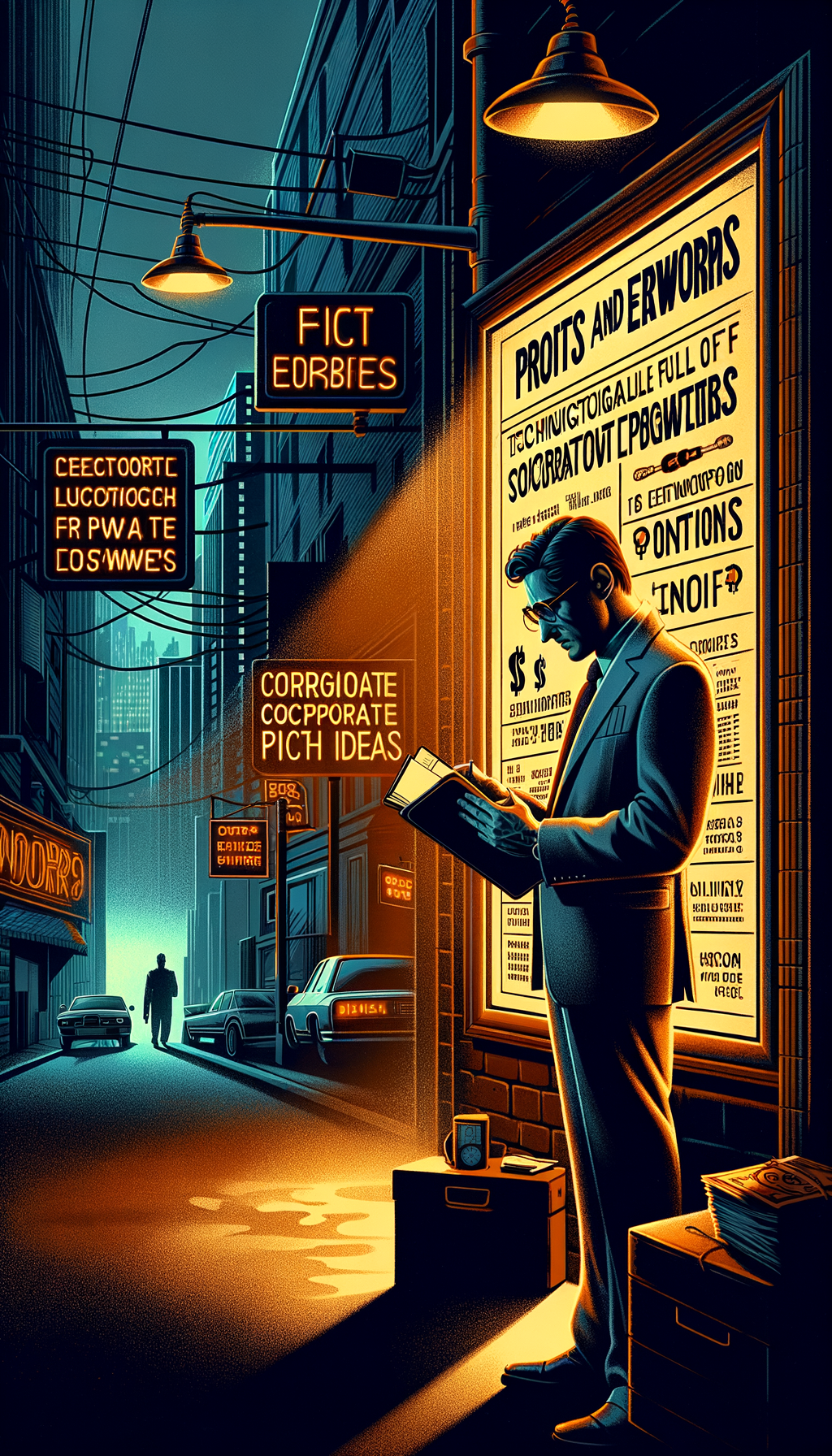
Lost in the Hum
The fluorescent tube above the conference table had been failing for at least three quarters, by Alex's estimate. It buzzed in that particular register that suggests no one whose job it is to replace it considers the room important enough to enter. Stale coffee in a glass carafe. Twelve chairs, askew at the angles their occupants had pushed them to. A whiteboard wiped down so many times it had developed a permanent gray fog, like a window onto weather. Alex Chen stood in the doorway and counted the chairs again, because counting was what he did when he couldn't immediately find the thing he was looking for. He was a technician. He counted ports, pins, electrode contacts, billable hours. He counted, now, the places where his notebook was not.
It was a blue notebook. Unremarkable. The kind sold in packs of three at the kind of store that also sells highlighters and disappointment. Inside it were forty-some pages of pitch ideas, written in the slightly embarrassed handwriting of a man who suspects his ideas are good but has been told for long enough that they aren't to hedge each sentence with a question mark. Onboarding flows. Consent screens that didn't feel like consent screens. A sketch of an icon shaped like an open hand. He had brought it into the meeting at ten. He had not brought it out at eleven thirty. Somewhere in between, a vice president had said the word synergy without irony, and Alex had set the notebook down to nod the way you nod when nodding is the cheapest currency in the room. Now it was gone.
He checked under the table. He checked the chair he'd been in, and then, for completeness, the chair he hadn't been in, on the theory that objects in corporate buildings drift. He checked the credenza, which held nothing but a tray of mints and a single dead fly. The fly, in its way, was also counting nothing. "You're back," said a voice from the hallway. It was Priya from facilities, who knew everyone's name because that was, technically, her job. She was carrying a clipboard and an expression of mild, professional patience. "I left something," Alex said. "People do." She paused at the threshold, didn't enter. "My mother used to say, you only really own the things you can carry out without thinking. Everything else owns you a little." Alex offered the small laugh that such sentences require. She moved on down the corridor, clipboard tapping against her thigh.
He stood for a moment with the sentence in his ear and then dismissed it the way one dismisses an email marked low priority. He had a notebook to find. The hallway curved. He had forgotten that it curved. The building had been built in one of those decades when curves were thought to make people feel calmer, and then renovated in one of those decades when calm was thought to be bad for productivity. The result was a corridor that arced gently while its lighting insisted you hurry. He retraced. The kitchenette, where he had refilled a paper cup. The printer alcove, where he had not printed anything but had stood, briefly, pretending to. The small unmarked conference room across from the large unmarked conference room, which is where, on the way in, he had taken a wrong turn.
The small room's door was open a finger's width. Voices inside. Alex slowed without deciding to. "The earworm effect," a woman was saying. Her voice had the flatness of someone reading off a slide she had read off many times before. "We're seeing involuntary recall at thirty-eight percent after a single Merge session. By session three it stabilizes around seventy. They don't experience it as advertising. They experience it as something they already knew." A man's voice, lower. "And attribution?" "They attribute it to themselves. That's the elegance. It feels like a memory." Alex's hand was on the wall. He hadn't put it there. "This is the soft version," the woman went on. "Consumer-facing. Jingles, taglines, brand affect. Once the population is comfortable with the modality, the Agency moves to the next layer. Directives. Compliance scaffolding. But we don't get there without this first. The commercials are the on-ramp."
"And the partners are aligned on sequencing?" "The partners," she said, "are aligned on whatever we sequence." Alex realized he had stopped breathing in the practiced way of a man who has spent his career around equipment that responds badly to breath. He realized, too, that he was standing in a hallway in a building he worked in, listening to two strangers describe his job from an angle he had not previously been shown. The man in the room laughed, briefly, at something not said aloud. A chair shifted. And then, quite casually, the woman said, "The interface notes were useful, by the way. The hand icon. We're going to use the hand icon." Alex took a step back from the door before his body had finished agreeing to it. The hand icon was on page eleven of a blue notebook he could no longer locate.
He did not go in. He did not knock. He walked, at the pace of a man who was definitely not walking quickly, back down the curved hallway, past the printer alcove, past Priya, who looked up from her clipboard and then, sensibly, looked down again. Outside, the air had the temperature of a season that hadn't decided yet. He stood on the concrete apron in front of the building and waited for the door to finish closing behind him, which it did, slowly, on a pneumatic hinge designed to prevent slamming. Somewhere under the noise of traffic, very faint, almost like something he had thought of himself, a small bright tune began to play. Six notes. Cheerful. He didn't recognize it, and then, a beat later, he did, the way you recognize a face in a crowd before you remember the name.
He stood on the concrete and listened to it loop.