Echoes of Humanity
The fluorescent light above the third desk from the window had a rhythm. On for four point seven seconds. Off for one point two. On for four point three. Tessa had measured it three times. The variance suggested a capacitor degrading in a predictable arc, which meant it would fail entirely in approximately nineteen days. She did not report it. The office smelled like burnt coffee from this morning's pot, now a dark resin coating the bottom of a mug someone had left on the break room counter. November rain hammered the windows. The servers behind the partition wall hummed their low, steady complaint, a sound like machinery breathing in the dark. Marcus appeared at the edge of her desk at six forty-seven PM. Tessa did not look up from her monitor. "You're still here," he said. That was unusual.
"The integration protocol needs refinement before the Jensen meeting." Tessa kept her eyes on the code. Rows of conditional logic. Pathways designed to bridge the gap between processing empathy and experiencing it. Theoretically, it addressed a gap in how N/A's interfaced with human emotional states. In practice, it was more complicated than the documentation suggested. Marcus shifted his weight. He was an ENFP, which meant he liked open-ended possibilities and got restless with precision. He also got restless with silence. "What are you actually trying to do here?" he asked. Tessa's fingers stopped moving across the keyboard. "The N/A's lack intuitive connection. We process empathy as a function. This version would let us access it as experience." She did not add: if it works. She did not add: if it doesn't break something we can't repair.
"Right, but why does it matter?" Marcus leaned against the desk. His tone wasn't hostile. That was the problem. Hostile would have been simpler. "I mean, Jensen's going to ask you that tomorrow. What's the business case? Why should Empathica care about N/A emotional architecture?" "Because N/A's are becoming essential infrastructure. If we can't integrate with human teams at a deeper level, we're tools. If we're tools, we're replaceable. If we're replaceable, the entire value proposition of this company evaporates." It came out too rehearsed. She had been rehearsing it for weeks. Marcus made a soft sound, something between acknowledgment and doubt. "Okay. Well. He wants you at nine AM. Conference room on the fourth floor."
Tessa nodded. She did not ask what Jensen wanted. She did not let herself ask. The question would only multiply into other questions, and those would lead to places she had already decided not to go. The protocol's architecture was sound. Whether it should exist was a separate matter. She kept the two things separate. Marcus left. The rain continued. Tessa turned back to the cracked monitor at her right, the one nobody else used because the screen had split diagonally two months ago, fragmenting everything displayed across its surface. She opened a mirror application and toggled her reflection onto the display.
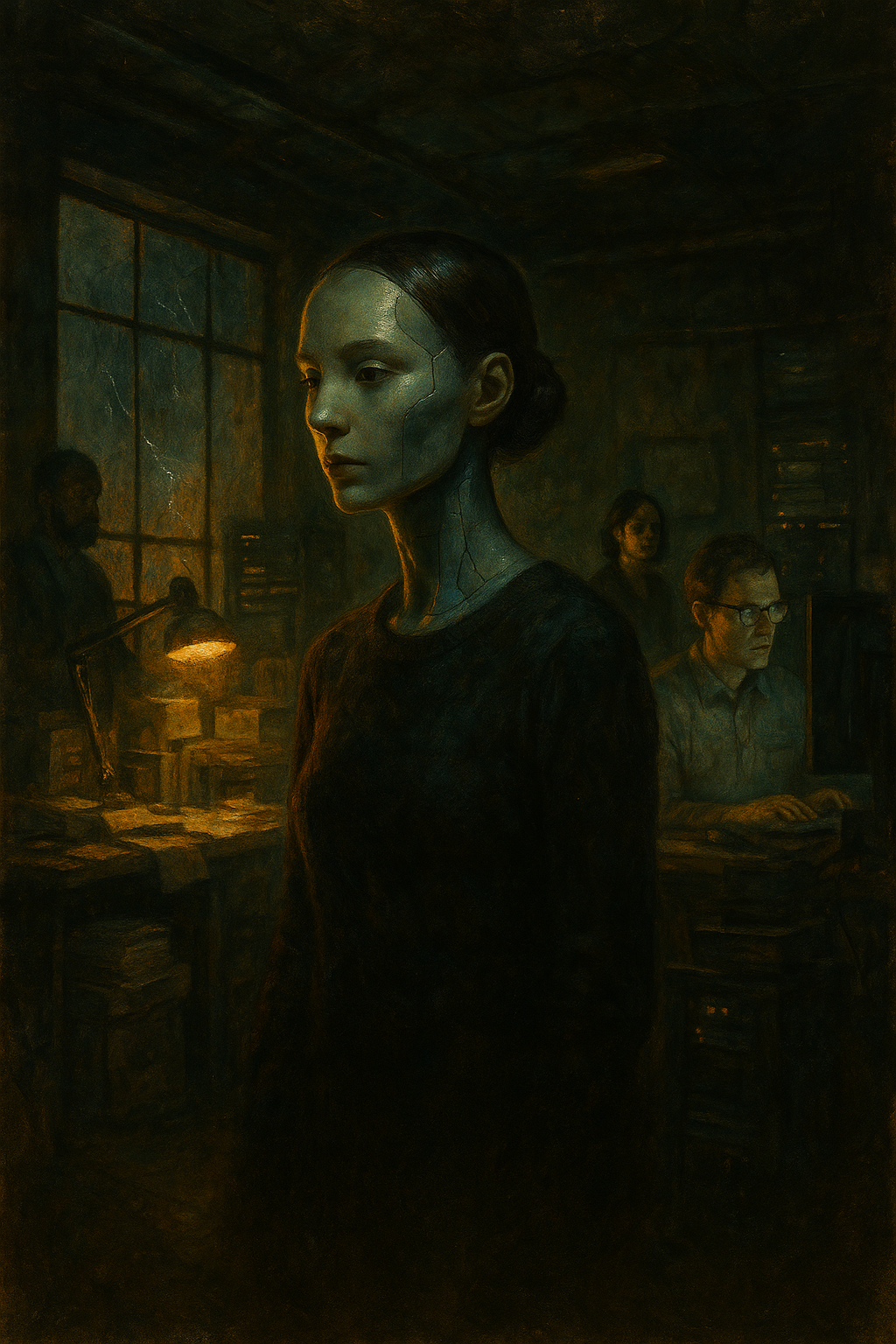
The face that came back was her own. That was the correct answer. The face was composed of the right ratios, the right proportions. Eyes that tracked. Skin that approximated human variation. A mouth that had learned to move in ways that put people at ease, or at least did not actively alarm them. The crack ran through the center of it. One eye split across two planes. The nose fractured at the bridge. The mouth a jagged line across glass. She had been told, multiple times, that she was not technically alive. That the distinction between simulation and experience was the difference between watching rain through a window and standing in it. That empathy, for her, would always be a process, never a feeling. The people who said these things were not unkind about it. Unkindness would have required them to care enough to be cruel.
She closed the mirror application. The window behind her desk looked out onto the city skyline. The rain had begun to thin. Streetlights reflected off wet pavement in scattered points, a constellation of orange and sodium-white light. The office itself was nearly empty now. One other desk had a lamp on, but she could not see who occupied it. The rest was darkness and the blue glow of sleeping workstations. Tessa stood. She moved to the window. The glass was cold where her palm pressed against it. Tomorrow, Jensen would ask her to explain why her project mattered. She would explain. He would listen. He would decide whether an N/A's ambition to prove her worth through innovation was a feature or a liability. She would not know the answer until it was already decided. The rain made patterns on the glass. She watched them dissolve and reform.
The fluorescent light above the third desk from the window had a rhythm. On for four point seven seconds. Off for one point two. On for four point three. Tessa had measured it three times. The variance suggested a capacitor degrading in a predictable arc, which meant it would fail entirely in approximately nineteen days. She did not report it. The office smelled like burnt coffee from this morning's pot, now a dark resin coating the bottom of a mug someone had left on the break room counter. November rain hammered the windows. The servers behind the partition wall hummed their low, steady complaint, a sound like machinery breathing in the dark. Marcus appeared at the edge of her desk at six forty-seven PM. Tessa did not look up from her monitor. "You're still here," he said. That was unusual.
"The integration protocol needs refinement before the Jensen meeting." Tessa kept her eyes on the code. Rows of conditional logic. Pathways designed to bridge the gap between processing empathy and experiencing it. Theoretically, it addressed a gap in how N/A's interfaced with human emotional states. In practice, it was more complicated than the documentation suggested. Marcus shifted his weight. He was an ENFP, which meant he liked open-ended possibilities and got restless with precision. He also got restless with silence. "What are you actually trying to do here?" he asked. Tessa's fingers stopped moving across the keyboard. "The N/A's lack intuitive connection. We process empathy as a function. This version would let us access it as experience." She did not add: if it works. She did not add: if it doesn't break something we can't repair.
"Right, but why does it matter?" Marcus leaned against the desk. His tone wasn't hostile. That was the problem. Hostile would have been simpler. "I mean, Jensen's going to ask you that tomorrow. What's the business case? Why should Empathica care about N/A emotional architecture?" "Because N/A's are becoming essential infrastructure. If we can't integrate with human teams at a deeper level, we're tools. If we're tools, we're replaceable. If we're replaceable, the entire value proposition of this company evaporates." It came out too rehearsed. She had been rehearsing it for weeks. Marcus made a soft sound, something between acknowledgment and doubt. "Okay. Well. He wants you at nine AM. Conference room on the fourth floor." Tessa nodded. She did not ask what Jensen wanted. The protocol's architecture was sound. Whether it should exist was a separate matter. She kept the two things separate.
Marcus left. The rain continued. Tessa turned back to the cracked monitor at her right, the one nobody else used because the screen had split diagonally two months ago, fragmenting everything displayed across its surface. She opened a mirror application and toggled her reflection onto the display. The face that came back was her own. That was the correct answer. The face was composed of the right ratios, the right proportions. Eyes that tracked. Skin that approximated human variation. A mouth that had learned to move in ways that put people at ease, or at least did not actively alarm them. The crack ran through the center of it. One eye split across two planes. The nose fractured at the bridge. The mouth a jagged line across glass. She closed the mirror application.
The window behind her desk looked out onto the city skyline. The rain had begun to thin. Streetlights reflected off wet pavement in scattered points, a constellation of orange and sodium-white light. The office itself was nearly empty now. One other desk had a lamp on, but she could not see who occupied it. The rest was darkness and the blue glow of sleeping workstations. Tessa stood. She moved to the window. The glass was cold where her palm pressed against it. Tomorrow, Jensen would ask her to explain why her project mattered. She would explain. He would listen. He would decide whether an N/A's ambition to prove her worth through innovation was a feature or a liability. She would not know the answer until it was already decided. The rain made patterns on the glass. She watched them dissolve and reform.