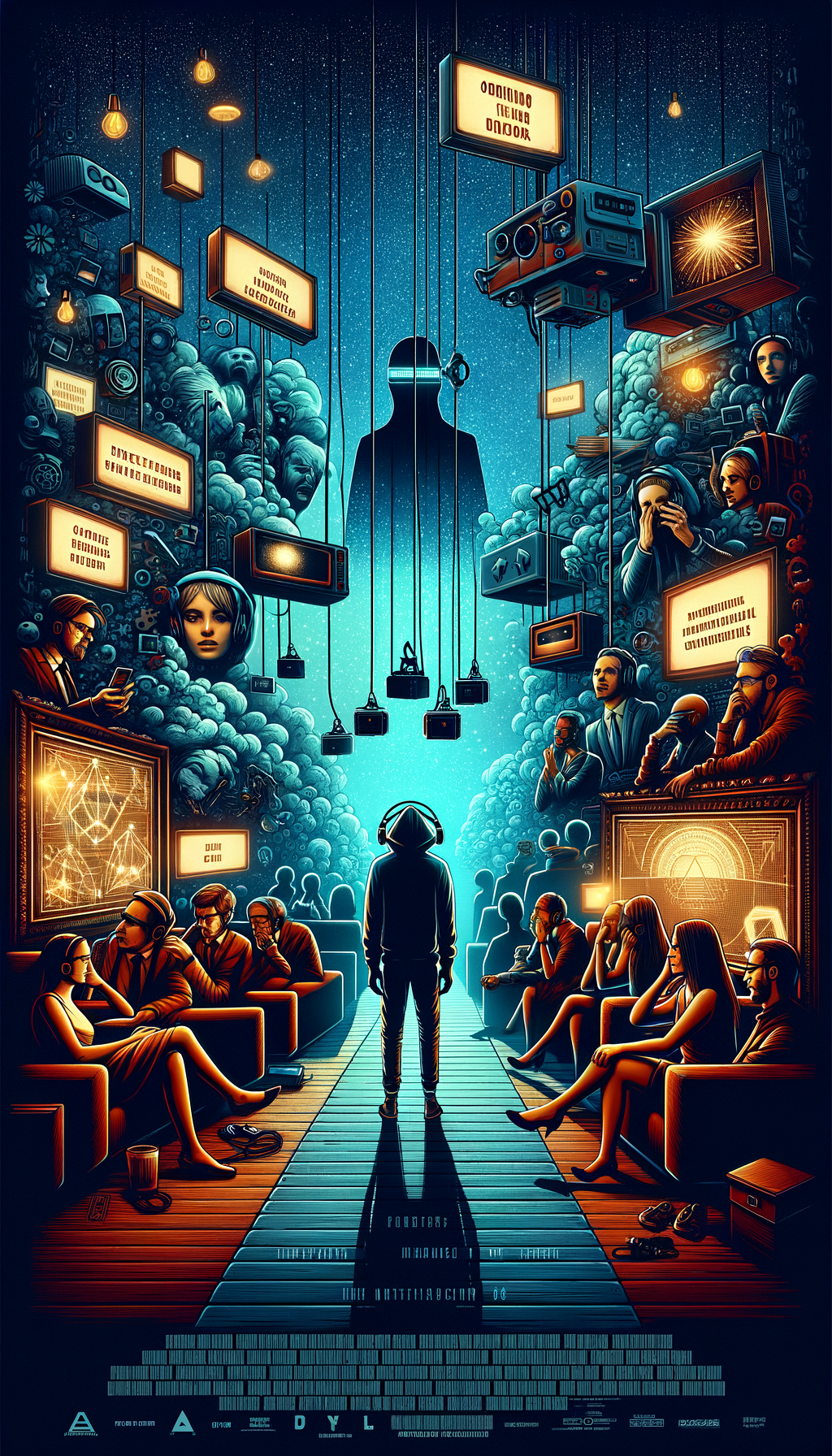
Poster for Opening the Fold

Opening the Fold

The CDA is unknowingly running a blackmail operation. Clients who have “merged” using the headset apparatus have “had the fold lifted” and during that time, a full recording of the last night’s dreams are available if you know which nerve to tap. A dark figure lets clients know that their dreams will be on display at the downtown art museum with their picture and name right next to the installation, which will be tastefully framed. Depending on the contents of those dreams, it could fetch ten thousand or more to keep the viewing from occurring. Lives had been altered for the worse for those who couldn’t pay.

Graphene
From The Turing Logs
Graphene
From The Turing Logs
← Back to overview

Opening the Fold

5 chapters · ~22 min read

novella

The CDA is unknowingly running a blackmail operation. Clients who have “merged” using the headset apparatus have “had the fold lifted” and during that time, a full recording of the last night’s dreams are available if you know which nerve to tap. A dark figure lets clients know that their dreams will be on display at the downtown art museum with their picture and name right next to the installation, which will be tastefully framed. Depending on the contents of those dreams, it could fetch ten thousand or more to keep the viewing from occurring. Lives had been altered for the worse for those who couldn’t pay.

Chapter 1 · ~4 min read

The Dream She Never Had

7:07

The intake form is laminated. The pen on the chain is still moving when Livia picks it up, a small pendulum drawing arcs over the white counter, and she watches it swing twice before she catches it. The clinic smells like nothing. That is the thing she will remember later, when she tries to remember things. The absence of a smell. A deliberate, expensive absence, the kind that costs money to maintain, the way silence in a recording studio costs money.

She writes her name in the box. Livia Or. Thirty-four. The address of an apartment she has lived in for six weeks. Under emergency contact she pauses, taps the pen twice against the laminate, and writes the name of a coworker she has known for eleven days. There is no one closer. This is not a thing she dwells on. It is simply true the way the weather is true. The receptionist takes the form without reading it and slides a tablet across. Initial here, here, and here. Livia initials. The tablet chimes politely. Somewhere behind a wall, a soft mechanical sound starts and stops, the way an HVAC system starts and stops, except it is not an HVAC system.

The Cognitive Decoupling Associates, the brochure had said, offer a proprietary integration of REM-stage memory and conscious attention, allowing clients to revisit, re-examine, and release. Release was the word that did it. She had circled it with a fingernail on the page until the paper softened. She has not slept through a night since she was nine. She has done the meditation apps. She has done the lavender. She has done a man in Encino who waved a tuning fork at her sternum for two hundred dollars an hour. Release.

The operator is a man in his early forties named Devran, though the badge only says D. Vann. He has the affect of a dental hygienist, which is to say competent, mild, and not quite present. He explains the headset. It is lighter than it looks. The straps adjust like a bike helmet. There is a gel pad that goes at the base of the skull, just above where the spine begins, and he warms it between his palms before he applies it, which is a small kindness she notices and files away as evidence that this is a real place where real people work.

“

Release was the word that did it.

He walks her through the breathing. He dims the lights in two stages. He tells her that whatever comes up is hers, and that the system does not interpret, does not store, does not judge. He says the word private twice in ninety seconds. She does not count, but her body counts. Her shoulders come down a quarter inch on the second one. She closes her eyes.

Devran watches the readout. The first minute is always nothing, a kind of warming, the brain figuring out it is being listened to. Then the waveforms begin to braid. He has seen this thousands of times. He has a daughter who is learning to play the cello and a mortgage that adjusts in eleven months and a brother in a facility upstate whose monthly cost is not a thing he describes to people at parties. On the console in front of him there are the labeled toggles, the ones that correspond to the printed manual, and there is one toggle below them that is not labeled. It is smaller than the others. It has been installed neatly, by someone who cared about the work. Her breathing goes slow. Her eyelids quiver in the particular way they quiver when a person has crossed over. He flicks the toggle.

Inside, Livia is nine. She is in a hallway she has not walked down in twenty-five years, and the carpet is the carpet, and the light under the door at the end of the hallway is the light under the door, and she can hear what she could hear, and she does not want to be here, she does not want to be here, but the body she is in is too small to leave and the door is opening and. The dream does what dreams do. It refuses to be looked at directly and insists on being looked at. She is crying in the chair. Devran notes this on the intake, in the box marked Emotional Release (Y/N), and circles Y, which is what the manual instructs. The other recording, the one happening below the labeled recording, does not require a box.

When she comes up, she comes up slowly. Devran is ready with water and a tissue and a voice pitched exactly between professional and warm. How do you feel, he asks. She says, I feel. She tries again. She says, lighter. She says, I think it worked. She laughs, a small wet laugh, and apologizes for the laugh, and he tells her there is nothing to apologize for, and she believes him, because why wouldn't she. He gives her a card with a follow-up number and a small foil packet of electrolyte powder and tells her to drink plenty of water tonight. He does not quite meet her eyes as he says it, but she does not notice, because she is not looking at his eyes. She is looking at her hands, which are steadier than they have been in a long time.

Outside, the afternoon has gone the soft gray of a city deciding whether to rain. She puts on her coat at the door and then takes it off again and folds it over her arm because the air feels good against her skin in a way air has not felt good in years. The glass door swings shut behind her. In the reflection she catches herself for a second, divided by the metal frame down the middle of her face, one half on the street and one half still inside, and then she turns, and the reflection turns with her, and she walks.

Next · Ch 2 →
The Price of Revelation
Chapter 2 · ~4 min read

The Price of Revelation

7:36

The phone lay face-up on the kitchen table like something that had landed there from a height. The message was still open. Its blue light pulsed against the edge of a cereal bowl gone soft in the middle, the flakes collapsed into a beige sediment, the milk skinned over. Livia had read it nine times. She knew because she'd counted the last four out loud, the way her mother used to count stairs in the dark.

The message was four lines. The first line was her name. The second line was the address of the downtown museum and a date, three weeks out. The third line was a number with four zeros after it. The fourth line was a description of a room she had only ever visited in her sleep, a room with green wallpaper and a man sitting in a chair with his back turned, and the specific, unrepeatable thing she had done in that room the night before her merge session. Nobody knew about the room. She had not known about the room herself until thirty hours ago, when the technician at the Cognitive Dynamics Annex had lifted what they called the fold and walked her, in the gentle voice they all used, back into the daylight.

Livia worked as a junior archivist at a university library. She made forty-one thousand a year before taxes. She had taken the merge session because her insurance covered it and her sleep had not been right for months, and because a woman she trusted, a coworker named Beth, had said it changed her life, said it like she meant the small, useful kind of change, the kind you can recommend. The number on the screen was ten thousand. She got up. She walked to the sink. She walked back. She sat down. She picked up the phone and put it down again without unlocking it, as if the message might have rearranged itself in the interim into something she could answer.

Here is what she did first, because people under pressure do small competent things before they do large ones. She googled the sender's handle. Nothing. She googled the phrase the message had used, a fold lifted, in quotes. The CDA's own marketing copy came up, and a few wellness blogs, and a forum thread from two years ago where someone had asked a question and then deleted their account before anyone answered. She googled her own name plus the museum. Nothing yet. She googled her own name plus the word dream. Nothing yet. The word yet was doing a lot of work.

She called the CDA's client services line. She got a recording. The recording was warm and unhurried and told her that her wellness was their priority and that a representative would be available Monday between nine and five. It was Saturday at eleven in the morning. She hung up before the beep. She thought about calling the police, and then she thought about what she would say to them, and then she thought about a uniformed officer reading the fourth line of the message aloud in a precinct, and she did not call the police. She opened her banking app.

This is the part that matters, so it's worth slowing down for. Livia had eleven thousand four hundred dollars in her savings account. She had been building toward it for three years. Rent was due in nine days. Rent was nineteen hundred. The math, if she sent the money, was the kind of math that doesn't survive contact with a single unexpected expense, a dental thing, a car thing, a friend's wedding she'd already said yes to. She tapped Transfer. She tapped External Account. She copied the routing information from the message and pasted it into the field. The app, helpful, asked her to confirm the recipient. The recipient was a string of numbers. She typed ten thousand into the amount field. The cursor blinked.

“

The number on the screen was ten thousand.

She looked at it. She looked at the soft cereal. She looked at her own hand, which was steadier than she would have guessed, and which she did not entirely recognize as belonging to her. She set the phone down. The cursor kept blinking in the amount field, patient as a metronome, while she sat there and did not press send and did not close the app and did not move.

What she was doing, in that long minute, was trying to locate the part of herself that knew whether the person on the other end already had what they said they had, or only said they did. She was trying to remember if she had signed something at the clinic. She had signed something at the clinic. She had signed several things. She had not read them, the way no one reads them, the way the forms are designed not to be read. She thought, with a clarity that surprised her, that if she paid once she would pay twice. She thought, with less clarity, that if she didn't pay, her mother would find out about the room.

She stood up. She left the phone on the table with the transfer screen still open and the cursor still blinking and the ten thousand still untouched in the amount field, and she carried the cereal bowl to the sink and turned on the tap. The water came in cold and fast. The bowl filled. The flakes rose and turned and softened further and began to lift off the ceramic in pale wet sheets. The spoon, which had been resting against the inside rim, shifted as the bowl tipped under the weight of the water. The handle came up. The bowl went down. The tap kept running. She did not turn it off.

← Previous · Ch 1
The Dream She Never Had
Next · Ch 3 →
Art of Deception
Chapter 3 · ~4 min read

Art of Deception

6:56

The afternoon light on the museum steps was the kind of light that flattered everything. It made the limestone look softer than it was. A sandwich board leaned against the balustrade, hand-lettered in a font someone had been paid too much to design. INNER LANDSCAPES: A DREAM SURVEY. OPENING THIS WEEK. Livia read it twice. Then she read it a third time, because the first two readings hadn't seemed to take. She had been, until that morning, a woman who paid her bills on time and kept her father's old watch in a drawer she rarely opened. She had merged once. One session. She had told no one. She had assumed, in the way people assume gravity, that what happened inside her own head belonged to her.

The email had arrived at four in the morning. The figure named in it was an amount she could almost pay, which was, of course, the point. She had spent the day in the kind of fog where you find yourself standing in your kitchen holding a spoon and not remembering why. She had told herself, on the bus downtown, that she was going to look. Just look. To know what they had. To see if it was a bluff. It was not a bluff. The lobby smelled like floor polish and the inside of a new book. A docent in a charcoal blazer smiled at her with professional neutrality and gestured toward the east wing without being asked. Livia thought, briefly, about how she must look. Whether her face was doing anything.

The gallery had been arranged as a soft maze, partitions set at angles so that you discovered each piece the way you discover bad news, one room at a time. The lighting was warm. The placards were the size of paperbacks. A small group of people stood in front of the first installation, murmuring the way people murmur in galleries, which is to say performing the act of being moved. The first piece was a still image, large, printed on something matte and expensive. A man in a kitchen, naked from the waist up, holding what looked like a hammer. Beside it, in clean sans-serif, a name. A photograph. A short paragraph in the tone museums use for everything, which is the tone of a person explaining a joke they find sad.

“

She had assumed, in the way people assume gravity, that what happened inside her own head belonged to her.

Livia did not recognize the man. She felt, for a moment, relieved, which was an emotion so misplaced she almost laughed. She kept walking. The second installation was a short looped video. A woman swimming through a hallway. The hallway was her childhood home, the placard explained, though of course it could have been anyone's childhood home. People stood and watched it loop. One of them was eating a small pastry from a napkin. Livia's heart was doing something her heart was not supposed to do. She could feel it in her throat and also, oddly, in her wrists. She rounded a partition.

The burning house. The child at the window. Her dream, the one she had not described to anyone, not to the technician, not to the intake form, not even, fully, to herself. Printed clean and large and lit from above by a small recessed bulb that cost more than her rent. Beneath it, in that same patient typeface, her name. Her photograph. The one from her CDA intake. She was smiling in it. She had been told to smile. A couple stood three feet from the frame, reading the placard. The woman tilted her head. The man said something soft. The woman nodded.

Livia's hand came up, halfway, before she understood what she meant to do with it. Tear the print down. Knock the placard sideways. Stand in front of it. Something. Anything. The docent at the gallery's mouth was at the corner of her vision, charcoal blazer, professional neutrality, and beyond him another docent, and beyond that a guard whose job was, presumably, this exact thing. She lowered her hand. The couple moved on to the next piece. A new couple took their place. The woman in the new couple wore a coat Livia almost recognized from a catalogue. They read the placard. They looked at her face on the wall. They looked at the burning house. They did not look at Livia, who was standing eight feet behind them, because there was no reason to.

She walked, carefully, the way you walk when you have been told the floor is wet, back out of the partition maze and into the corridor outside the gallery entrance. She put her palm flat against the wall. The wall was cold in the way old buildings are cold even in summer, holding onto something the season hadn't reached yet. Inside, the murmuring continued. Someone laughed, briefly, and then stopped, embarrassed, the way people laugh in galleries when they forget where they are. In front of her, set into the wall, was a display case that had not yet been filled. The glass was dark. She could see her own face in it, dim and doubled. Her breath fogged a small patch near her mouth and then, slowly, cleared.

She did not yet know what she was going to do. She knew only that the amount in the email had, in the last four minutes, stopped seeming large.

← Previous · Ch 2
The Price of Revelation
Next · Ch 4 →
The Fold Unravels
Chapter 4 · ~5 min read

The Fold Unravels

8:09

The diner two blocks east of the museum is the kind of place that doesn't have a name on the door anymore, only the ghost of one in the paint. Livia sat in the corner booth with her back to the wall, which is what people do in movies before they understand why. The coffee across from her, ordered by someone else and forgotten, had stopped steaming. A skin had begun to form on top of it. She watched it the way a person watches a clock when they're trying not to look at the door.

She had walked here in a straight line from the installation. She remembered that part. She did not remember crossing the second street, or whether the light had been with her. Her name on the wall, printed in the same restrained serif the museum used for Rothko and de Kooning, had done something to the wiring. She kept touching the inside of her wrist where the headset cuff had sat three weeks ago. There was no mark there. There had never been a mark there. That was sort of the point of the cuff. The figure who slid into the seat opposite her did so without ceremony. A coat the color of wet pavement. A face that was difficult, afterward, to describe to yourself. Not because it was hidden but because it was the kind of face that declined to be the subject of the sentence.

“

She kept touching the inside of her wrist where the headset cuff had sat three weeks ago.

"Don't get up," the figure said, which Livia had not been planning to do. "I'm sorry about the coffee. I ordered it before you came in so the waitress wouldn't pay attention to when I sat down." Livia, who worked in procurement for a midsize logistics firm and had once, in college, briefly considered law school, recognized this as the talk of someone who had done this before. More than once. Possibly often. "You saw it," the figure said. "I saw it." "How much did they ask for?" "Twelve."

The figure nodded as if twelve were a reasonable number, a fair number, a number consistent with a pricing model they had studied. "That tracks. They look at your tax bracket. They look at what you'd lose. You're not married, so it's not the spouse angle. You have a sister you talk to on Sundays, so it's the family angle. They priced you for the sister." Livia's hand went flat on the table. She did not remember telling anyone, ever, about the Sunday calls. "I'm not here to scare you," the figure said. "I'm here because scaring you is what they do, and somebody has to do the other thing." "Which is what." "Show you the shape of it."

From the inside of the coat came a manila envelope, unmarked, and the figure slid it across the formica with two fingers, the way you'd push a chess piece you were no longer sure about. Livia opened it.

It was her file. She knew it was her file before she'd read three lines, because the first dream listed was the one with her mother and the swimming pool, and she had never told anyone about the swimming pool, not the intake therapist, not the technician, not the soft voice on the headset that asked her to count backward from forty. The dream was logged. Time stamped. Cross referenced. Across the top, in a font she recognized from her own welcome packet, was the Cognitive Dynamics Agency seal, and beneath that, a client number she had memorized for billing purposes, and beneath that, a routing stamp she did not recognize at all. Internal. Departmental. Initialed. She looked up. "This wasn't hacked," she said. "No." "This was walked out." "Yes."

She sat with that for a moment. The diner's overhead fluorescent did the small flicker fluorescents do. Somebody at the counter laughed at something on a phone. "Who," she said. The figure watched her. Not unkindly. The way a person watches a kettle they've been waiting on. "I'll give you the name," the figure said. "I will. But not today." "Why not today." "Because if I give it to you today, you go home and you sit with it, and in three days you call the number on the back of your CDA card and you ask to speak to someone about a billing concern, and you mention the name, and you die in a car accident on the Lincoln overpass. I've seen that movie. I don't like how it ends." "So when." "When you go back in."

Livia did not answer immediately. She was aware, distantly, of her own pulse in the side of her neck. "Back in to the CDA." "One more session. You're already scheduled. You don't cancel. You go. You wear the cuff. You let them do what they do. And while you're in the building, you do one small thing for me, and when you walk out, I tell you the name, and after that you decide what kind of person you want to be about it." "What's the one small thing." "We'll discuss it." "We're discussing now." "We're not, actually," the figure said, with something that wasn't quite a smile. "You're deciding whether I'm real. That's the only conversation happening at this table." Which was true, and Livia disliked, intensely, that it was true.

She looked down at the envelope. At her own name, her own number, her own swimming pool. At the routing stamp from inside the building she had walked into willingly, twice, with her ID out and her sleeve already rolled. When she looked up, the figure was standing. She hadn't seen them stand. "Think about it until Thursday," the figure said. "After Thursday it isn't an offer." They left a ten on the table for the coffee neither of them had drunk, and walked out, and the bell above the door did the thing bells do, two notes, the second one quieter than the first.

Livia stayed in the booth. Across from her, the empty seat held the shape of someone for about a second and then didn't. The coffee sat between them, cold now, a pale ring forming where the cup met the saucer. Her hand was still on the open envelope. Her thumb was on her own name. Outside, on the sidewalk, a woman walked past with a dog, and then a man with a folded newspaper, and then no one for a long time.

← Previous · Ch 3
Art of Deception
Next · Ch 5 →
Secrets in the Machine
Chapter 5 · ~5 min read

Secrets in the Machine

8:45

The service corridor ran the long axis of the building, narrow as a spine. Livia walked it with her shoes in her left hand and a borrowed lanyard against her sternum, and the floor under her sock feet hummed at a register she felt more than heard. Behind a steel mesh door to her right, the server racks stood in their cold blue weather. A few green diodes blinked out of phase, like insects deciding whether to leave.

She had ninety minutes. That was what she had been told. The man she'd met in the parking garage of the public library, the one who would not give her a name and who held his coffee in both hands as if it might run, had said ninety minutes from badge-in to badge-out, and that the night operator named Devin took a long dinner at a Thai place two blocks south on Wednesdays. It was Wednesday. The lanyard around her neck said DEVIN R., COMPLIANCE, and the photograph on it was of a man with a goatee and the particular tiredness of someone who had been promoted into a role he did not understand.

Livia is, for what it's worth, not trained for this. She runs a small bookkeeping practice out of the second bedroom of a rented bungalow. She has, on her refrigerator, a magnet that says BREATHE. She had used the CDA's headset apparatus four months ago because her sister had recommended it for the grief, and because the brochure used the word integrative. The terminal was where the man had said it would be, in a glass-walled room labeled OPS 2, on a desk among three other desks, the only one whose screen was still awake. A half-eaten protein bar sat on a napkin. The monitor showed an email client and a minimized window titled simply ARCHIVE. She sat down in Devin's chair, which was warm in a way she tried not to think about, and she clicked. The archive opened to a login prompt she had not been warned about.

“

Livia is, for what it's worth, not trained for this.

She stared at it. The cursor blinked at her with the patience of something that had all night. The man in the garage had given her a string of characters on a piece of receipt paper, and she typed those characters in, and the prompt shook its head at her in the polite digital way and asked again. She tried it lowercase. She tried it without the trailing digit. The prompt asked a third time and then, beneath the field, in small gray letters, it noted that further attempts would be logged.

Her hand on the mouse had gone cold at the knuckles. She sat back. She looked at the protein bar. She looked at the sticky note pressed to the underside of the monitor's lower bezel, half hidden by a curl of tape, where someone, probably Devin, had written six characters and a exclamation point in ballpoint pen, the way people do when IT makes them change their password every ninety days and they have given up on dignity. She typed it in. The archive opened.

What scrolled was not what she had expected, which had been her own name and a file and perhaps a way to understand what had been done to her. What scrolled was a directory. Folders by year, by quarter, by month. She opened the current month and the list came down the screen in a long quiet rain. Names. Hundreds of them. Last name, first name, a client ID, a date, and a status field, and the status field said one of three things. RECORDED. SETTLED. DEFAULTED. She scrolled. The names did not stop. She scrolled faster and the names kept coming, and then on the third row of the screen her eyes caught on one and her hand left the mouse entirely.

It was a name she knew. Not a stranger. Not a headline. Someone whose birthday was in her phone. Someone who had sat at her kitchen table eight weeks ago and laughed about a dog and asked for more bread. The status field next to the name read SETTLED, and there was a number in the column after it, and the number had four zeros in it. She did not, in that moment, do any of the things a person in a film would do. She did not gasp. She did not stand. She put her palm flat on the desk beside the keyboard and she felt the laminate, which was cool, and she counted to four on the inhale and four on the exhale, the way the magnet on her refrigerator had instructed her to, and she went on reading.

There were people on this list who taught at the community college. There was a name she recognized from a campaign sign on a lawn near her own. There was a priest. There was, three pages down, a woman she had stood behind in line at the post office last spring, who had been mailing something to a grandchild and had complained, warmly, about the price of stamps. The pattern was not subtle once you saw it. RECORDED meant a session had been captured. SETTLED meant a payment had cleared. DEFAULTED meant something else, and Livia did not, at this hour, with the clock she was carrying in her chest, let herself open one of those files to find out exactly what.

She pulled the small drive out of her pocket. It was the cheap kind, blue plastic, the kind that comes free at trade shows, and she slid it into the port on the side of the monitor and she began to copy. The progress bar moved with the unhurried indifference of municipal infrastructure. She watched it and she watched the door to the corridor and she watched the clock in the corner of the screen, which read 8:47, and she thought about how long a person took to eat pad see ew, and she thought about whether Devin was the kind of man who ordered dessert.

The bar reached one hundred percent. She ejected the drive. She closed the archive. She closed the folder. She wiped the mouse and the edge of the desk with the sleeve of her jacket, which she understood was probably theater, and she pulled the drive free and closed it inside her fist so tightly the plastic edge bit into the soft place below her thumb. Behind her, the screen went dark and then began, very slowly, to pulse. A soft blue circle, expanding and contracting at the rhythm of a sleeping animal. In and out. In and out. She did not look back at it. She was already in the corridor, shoes still in her hand, walking toward the door she had come in through, listening, under the hum of the racks, for the sound of a key card at the far end of the hall.

← Previous · Ch 4
The Fold Unravels
Back to show →
Opening the Fold