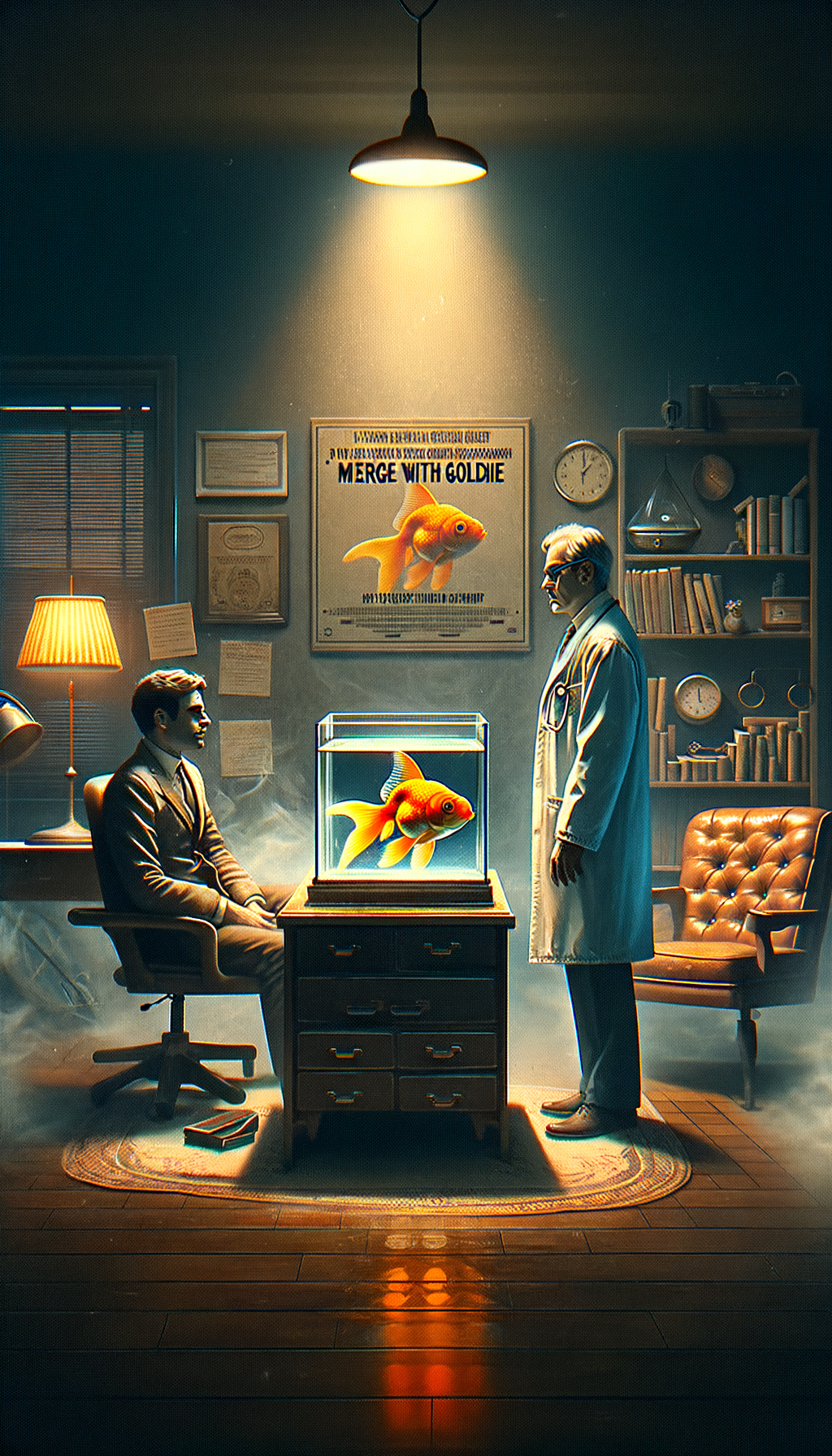
Poster for Merge with Goldie

Merge with Goldie

The doctor offers merging consciousness with the goldfish on her bookshelf in her office as a way out for an unhappy client who has discovered their reality

Graphene
From The Turing Logs
Graphene
From The Turing Logs
← Back to overview

Merge with Goldie

8 chapters · ~31 min read

novella

The doctor offers merging consciousness with the goldfish on her bookshelf in her office as a way out for an unhappy client who has discovered their reality

Chapter 1 · ~4 min read

The Weight of Water

6:59

The bowl sat on the shelf behind Dr. Harper's desk, catching the overhead light in a way that made the water look like it was humming. The filter produced a steady, almost musical burble. Not actually humming, of course. Max knew the difference between sound and the suggestion of sound. He'd become very good at noticing the difference. Harper's office held the kind of warmth that came from thick carpet and a radiator that never quite clicked off, all muted grays and the smell of old books that nobody actually read. The kind of place where people came to say things they couldn't say anywhere else. Max was here to prove he was fine.

A standard wellness check, they called it. The CDA had made him do a behavioral evaluation two months ago. He'd smiled back at the assessor, the same smile he'd used three times that week. That was the deal. You showed up. You answered the questions. You reported that your metrics were good. You left. Then you came back in six weeks and did it again. Harper's pen moved in steady arcs across her notepad while her eyes stayed on Max. The kind of attention that felt less like being seen and more like being catalogued. She was younger than he'd expected, maybe forty, with the posture of someone who'd learned to sit very still. "How are you sleeping?" she asked. "Fine." "Appetite?" "Normal." "Energy levels?" "Good."

These were the true answers, or close enough. He wasn't lying. The CDA's metrics wouldn't flag him if he was. His sleep was adequate. His diet met nutritional requirements. His body performed the functions it was supposed to perform. But somewhere between adequate and fine, something had gone wrong with the machinery of wanting anything at all. Harper set the pen down. It rolled slightly on the desk before stopping. "You're dissatisfied," she said. Not a question. Max didn't answer. The radiator clicked. "That's not unusual," Harper continued. "Most people are. But most people manage it. They find small satisfactions. Work, relationships, projects. Meaning-making exercises." She glanced at him. "You haven't." "I've tried." "Have you?"

“

The CDA had made him do a behavioral evaluation two months ago.

The water in the bowl behind her continued its false humming. Max found himself watching it instead of her face. Easier that way. The goldfish inside was small, orange, unremarkable. Its name was Goldie, which was the kind of joke that only worked if you weren't thinking about it too hard. He tried not to think about it too hard. "What would it take," Harper said, "for you to feel like you were actually living? Not performing the acceptable version of living. Actually living."

Max's shoulders had already started to drop before she finished speaking. This was the part where he was supposed to produce some insight about himself, some latent desire he'd been suppressing. Some answer that would satisfy her and get him back out the door in time for his next obligation. But the truth was simpler and worse: he didn't know. The question itself felt like it had been asked in a language he used to understand. "I don't know," he said. Harper picked up her pen again. Didn't write. Just held it. "There's something I want to try. It's unconventional. It's not in any handbook. The CDA would likely disapprove." She paused. "But I think you might benefit from it." Max waited. The filter burbled. Somewhere in the building, a door closed quietly.

"I can help you merge your consciousness with Goldie," Harper said. "Temporarily. A few hours at most. You would experience her existence. Her perspective. Her absence of the things that are making your life feel like a weight." The words were landing in the wrong order. Or maybe they were landing perfectly and Max's ability to assemble them into sense had simply failed. He looked at the goldfish. Goldie swam in a small circle, turned, swam in the same circle again. The bowl was smaller up close. The water had settled into pure stillness. "You've done this before," Max said. It wasn't really a question. Harper didn't answer immediately. The pen stayed on the desk. Then: "I have very good insurance."

Max couldn't tell if that was a yes or if it was Harper's way of avoiding one. He couldn't tell if consciousness transfer was something that was possible in this world or if he was sitting across from someone who'd stepped outside the frame of what was real. But he also couldn't tell if it mattered anymore. The radiator clicked again. His chest felt very small. "How would it work?" he asked. "We'd start with meditation. Guided visualization. Something to quiet the parts of you that insist on being Max. Once you're receptive, I'd introduce you to Goldie's neural signature. There's technology for this. Not widely known. Not widely approved of." Harper leaned forward slightly. "But it works."

Max looked at the fish again. Goldie had completed another circuit of her bowl. The same circle. The same water. The same four inches of space to call a world. And yet something in that repetition felt like mercy. "What happens if I say no?" he asked. Harper's expression didn't change. "You'll finish your wellness check. You'll leave. You'll come back in six weeks. You'll do this again." That wasn't an answer. That was a description of what was already happening. Max stared at Goldie, who swam lazily in her circle, oblivious to the weight that had just settled into the room, to the proposition hanging in the air between them, to the fact that Max was considering it—actually considering it—as though it were a real choice instead of just another version of the same impossible weight, repackaged and offered with slightly different terms.

Next · Ch 2 →
Drowning in Thought
Chapter 2 · ~4 min read

Drowning in Thought

6:48

The waiting room smelled like copper and bleach. Max sat with his hands flat on his thighs, the fabric of his pants damp at the seams. He'd been here for seven minutes. He counted. His fingers tapped once against the armrest, then stopped. He didn't want to seem nervous. Dr. Harper's office door was closed. Through the frosted glass, he could see her shape moving, could see her hand reach for something on the shelf. The goldfish bowl caught the overhead light. He'd seen it last session. Small, orange, utterly indifferent to the world pressing in around it. He wondered if that was the point.

The door opened. Harper stood in the frame, her blazer a precise gray, her expression the kind of blank that takes effort to maintain. You've had time to think about what we discussed, she said. It wasn't a question. She moved back into the office and he followed, his shoes making a sound on the tile that seemed louder than it should. The bowl was on her desk now. The fish turned in a slow arc, its gills working. Max sat across from her and watched it move. Yes, he said. And? I'm still not sure what you're asking me to do. Harper leaned back in her chair. Her fingers rested on the desk, perfectly still. You're asking me to merge with a fish, Max said. His voice came out thinner than he wanted. That's what you said last time. I'm asking if you want to try it.

The word 'merge' hung there. Max could see her watching him, could see the slight elevation of one eyebrow. He didn't know what it meant. He'd spent three days not knowing what it meant. He'd gone to work. He'd eaten a sandwich. He'd stood in his apartment at two in the morning looking at his hands and wondering if they were his hands or the memory of hands, and whether that distinction mattered anymore.

“

Resistance is often just the mind protecting itself from what it doesn't yet understand.

He thought about the carousel. His daughter's hand in his, small and hot. She was six. She was always six in the memory. There was a horse with a chipped ear and she kept pointing at it, kept saying that one, that one, and he kept pulling her toward the other horses because the chipped one was in the back and he didn't want to wait. The mirrors on the carousel broke the light into fragments. She was crying. Or maybe that was a different memory. The carousel kept spinning and she was still pointing and he was still walking away from the chipped ear. That was years ago. He wasn't sure if it was real. Max? He blinked. Harper was watching him. How much of this is real, he said. The question came out before he could stop it. How much of what I remember is actually mine?

Harper's expression didn't change. Some resistance is natural. Resistance is often just the mind protecting itself from what it doesn't yet understand. That's not an answer. No. It isn't. She turned slightly in her chair. The goldfish was between them. It had stopped moving. Not stopped, exactly. Just paused in its rotation, suspended in the water like it was thinking about something. Max watched it. The fish's eye was a dark point. It didn't blink. It never blinked. Why me, he said. Why what? Why are you offering this to me? Harper looked at the bowl. The fish resumed its slow turning. Because you want a way out, she said. And most people don't have the luxury of wanting one.

There was something in her voice then. A crack. Just for a moment. Max saw her hand move toward the bowl, then stop. She pulled it back. Her fingers returned to their original position on the desk, and her face reassembled itself into its previous neutrality. He thought about the man from the CDA. The suit. The smile that wasn't a smile. The things he'd said about people like Max being flagged. About anomalies in the system. About how the agency kept records of people who questioned the shape of their own lives. What if I say no, Max said. Then you don't merge. And you continue being unhappy. Simple as that. Yes.

Max looked at the goldfish. It moved through the water with no resistance, no thought about whether the water was real or constructed, whether the bowl was a prison or a home. It simply existed in the space it occupied. It didn't remember carousels. It didn't have a daughter. It didn't have a CDA file. It was so small. The whole thing was so small. All of it contained in a bowl no wider than his hand. I think, Max said. His voice was uncertain. I think I want to try. Harper nodded. It was a small gesture, barely a dip of her chin. But he saw her shoulders shift. Saw something in her expression that might have been satisfaction, or might have been something else entirely. She reached for the bowl and pulled it closer to the edge of her desk.

Then we should start with the water, she said.

← Previous · Ch 1
The Weight of Water
Next · Ch 3 →
Reflections of a Shattered Self
Chapter 3 · ~4 min read

Reflections of a Shattered Self

6:48

The bubbling started before Max saw the apparatus. Cool mist settled on his skin as Dr. Harper adjusted the electrode array against his temple, her movements precise and practiced. The sterile room smelled like mineral water and something clinical he couldn't name. She'd explained the process twice since he'd agreed to this, and he'd stopped listening after the first run-through. He was here now. That was the only fact that mattered. Dr. Harper's voice slowed, each word separated by a half-beat, like she was reading from a script she'd memorized but didn't quite trust. Something about relaxation. Something about letting the apparatus guide the transition. Something about how the first merge would be brief, a trial run to establish baseline compatibility. Max nodded at the right moments. His hands rested on the arms of the chair, and he watched them as if they belonged to someone else.

The mask came down over his face. Warm water, not cold. The kind of temperature that doesn't announce itself, just becomes the world. He was told to breathe normally. He was told to think of nothing. He was told to let Goldie's consciousness guide the experience. Then the water rose, and thinking stopped being an option. It was blue. Not the blue of the tank in Dr. Harper's office, but something deeper. The blue of memory. The blue behind closed eyelids in sunlight. He was moving through it without effort, without the weight of limbs or the effort of wanting to move. Released. Just like that.

And for a moment—maybe longer, time wasn't a thing here—he understood what it meant to exist without the architecture of self. The apartment with the radiator that clanked at 3 a.m. was gone. The job that had never made sense was gone. The creeping knowledge that something was fundamentally wrong with the world, or with him, or with the way the two fit together—it was all gone. The water held him. It didn't ask him to be anything.

“

The kind of temperature that doesn't announce itself, just becomes the world.

He swam through corridors of light. Some of them were his memories. Some were Goldie's. The distinction didn't matter. He was experiencing her seeing Dr. Harper arrange books on the shelf, the room beyond the glass tank shifting in colors he had no names for. He was remembering his mother's kitchen, but through Goldie's eyes, which meant the kitchen was vast and terrible and beautiful all at once. Memories without the weight of having lived them. Just sensation. Just the drift. Then something moved beneath the surface. At first he thought it was part of the drift, another current in the blue. But it had edges. Shapes. They moved like things with intention, circling in the deeper water below him. He told himself not to look. He told himself to stay in the light. But the shapes were already looking at him.

He knew them. That was the worst part. He recognized them. They were the quiet voice that told him he was wrong. They were the feeling that had no name, the one that woke him at 3 a.m. when the radiator clanked. They were every moment he'd ever felt like he was watching his own life from outside it, like he was a passenger in his own skull. They rose through the water without rushing, without hurry, because they didn't need to. They had time. They had always had time. Max's lungs seized. Then something in the water—or in him—unclenched, and he could breathe again. But the blue was different now. Darker at the edges. The light that had held him was still there, but it was smaller. He was seeing it from farther away.

Goldie's endless circle became visible below him. Her tail moving in that hypnotic figure-eight, tracing the same path she always traced. Over and over. Around and around. She'd never left the tank. She'd never wanted to. The circle was enough for her. The circle was everything. He watched her swim, and something in his chest tightened. The apparatus released him in stages. The water drained. The electrodes went quiet. Dr. Harper's voice came back first, asking him to focus on her face, to come back to the room, to remember where he was. As if he could forget. As if anywhere else was an option. He gasped. The cold air hit his skin and felt like punishment.

Dr. Harper was watching him with an expression he couldn't read. Her pen was already moving across her clipboard. She asked him what he'd experienced, but her eyes were looking for something specific. Something in his vitals, maybe. Something in the way he was breathing that told her whether the merge had worked or whether something had gone wrong. Max didn't answer right away. He was still thinking about the water. How for a moment it had felt like escape. How the darkness had risen anyway. Dr. Harper waited. Her pen didn't stop moving.

← Previous · Ch 2
Drowning in Thought
Next · Ch 4 →
The Fishbowl Trap
Chapter 4 · ~3 min read

The Fishbowl Trap

4:13

The office was colder than it had been three days ago. Max noticed it the moment he sat down, the kind of cold that has nothing to do with temperature. Harper was at her desk, pen in hand, waiting. Goldie swam her familiar circuit in the bowl behind her, orange and oblivious. Max had started talking before he even settled into the chair. I was everywhere, he said. The water—it was like my nervous system. I could see in directions that don't have names. I could feel the current from the filter like it was my own breath. And I knew—I mean, I absolutely knew—that Goldie wasn't thinking in words. She was thinking in pressure and light and the memory of food. And I was both things at once.

Harper wrote something down. Not a note. Not a reaction. Just a mark on her pad, the kind you make when you're checking off a box. It's perceptual retuning, she said. Your nervous system integrated with another state. Usually fades in two, three weeks. Max waited for her to say something else. To ask him how it felt emotionally, or whether he'd slept, or any of the things a therapist asks when someone has just described the dissolution of their own consciousness. Instead she turned a page in her file. Has anything felt strange since the merge ended, she asked. Strange how. Disorientation. Gaps in memory. Difficulty maintaining your sense of self. No, Max said. If anything, I felt more like myself. Like I'd been wearing a suit that didn't fit and someone finally took it off.

Harper set her pen down. She looked at him the way you look at a piece of equipment that's performing better than the specs predicted. Not warm. Not particularly interested in him. Interested in the data. Would you do it again, she asked. The question arrived without preamble, without context. There was no clinical scaffolding around it. No discussion of risks or protocols or the ethics of consciousness merging. Just the question, sitting there like a door she'd left open. Max's chest tightened. He heard himself say yes before he'd assembled a reason. The word came out before the thought that produced it, which meant the thought was already inside him, waiting. I want another merge, he said. Harper didn't reach for her pen. Didn't shift. Just waited. As if she'd already known what he would say. As if the knowing had been part of the design.

“

Like I'd been wearing a suit that didn't fit and someone finally took it off.

There are others interested in this work, she said finally. People who understand what we're building here. The merge isn't therapeutic. It's investigative. We're mapping consciousness. Seeing what happens when the boundaries dissolve. Your data is valuable. Max heard the word data and something in him registered it as wrong. The same way you hear a sound at three in the morning that makes your spine tighten. But the sound was already fading by the time his mind caught up to it. When can I do it again, he asked. Next week. Same time.

Harper stood, which meant the session was over. Max stood too, because that's what you do when the person across from you decides the conversation has ended. He moved toward the door. His hands were shaking slightly, the way they shake when you've made a decision you understand you can't unmake. When you've committed to something and the commitment has already begun carrying you forward, momentum in a direction you didn't choose but can't now refuse. Behind him, Goldie completed another circuit. Orange body, small brain, no choice in the matter at all.

← Previous · Ch 3
Reflections of a Shattered Self
Next · Ch 5 →
An Ocean of Lies
Chapter 5 · ~4 min read

An Ocean of Lies

7:03

The clock on Max's desk ticked through the silence. Quarter past three. He'd been staring at the same paragraph for twenty minutes, his eyes moving across the words without the sentences assembling into meaning. The document was from the CDA archives, buried three folders deep in a shared drive he wasn't supposed to access. He'd found it by accident, or so he'd told himself. The memo listed benefits as if selling a product: reduced problematic autonomy, increased compliance, enhanced neural integration. Below each metric was a percentage. Ninety-four percent. Eighty-seven percent. Seventy-one percent. His hands were shaking. He blamed the four cups of coffee since morning, the empty mugs lined up on the desk like evidence.

Merging with Goldie meant you couldn't tell where you ended. That was what Max had started to understand in the past week. Not just philosophically. Physically. When he tried to remember whether he'd decided to skip breakfast or whether the impulse had come from somewhere else, the answer wouldn't hold still. When he looked at his own handwriting, it sometimes looked foreign. When he caught himself staring at the fish tank in Harper's office last Tuesday, he'd forgotten, for a moment, that he was the one looking. But the back of his neck prickled. The way it did when someone stood too close.

The memo didn't use the word control. It used integration. Optimization. Synchronized consciousness matrices. There was a section marked "Behavioral Modification Through Merge" that discussed something called "personality blending stabilization," and Max had read it three times, trying to decide if they meant what he thought they meant. The researchers seemed to celebrate what they called reduced problematic autonomy. Reduced. As if autonomy was something you could trim back like a hedge. He closed the document. Opened it again. Closed it. Reality wasn't supposed to work this way. Harper had promised the merge would feel natural by week six. It was week fourteen. And instead of feeling more like Goldie, Max was feeling less like himself, which shouldn't be possible. You couldn't lose yourself if there was nothing else in there taking up the space. Except there was.

“

That was what Max had started to understand in the past week.

He got up from the desk and walked to the bathroom mirror. His reflection looked back at him. For a moment, he watched his own face without quite recognizing it. Then the moment passed, and it was just Max again. Stubble. Dark circles. A scar on his chin from a fall he remembered, or thought he did. The face tracked his movements with fractional-second lag. Like watching a video of himself with the audio slightly out of sync. He gripped the sink. The porcelain was cold. Real. Something he could verify through sensation, the way Harper had taught him. Touch something. Name it. Confirm that you're still the person touching it. But he wasn't sure anymore.

The impulse came before he could stop it, rising up from somewhere he couldn't locate. He needed to call Marcus. The thought arrived fully formed, urgent, as if it had been waiting inside him for days. Max recognized the impulse as something that might not be his own, and he didn't know how to tell the difference anymore. He dialed before the recognition could paralyze him. Marcus answered on the third ring. Said it was good to hear from him. "How've you been?" Marcus asked. "Fine," Max said. The word came out automatic. "Listen. I need to ask you something. When you merged with the ferret, did anyone from the CDA ever tell you what the merge actually does?" There was a pause on the other end. A long one. "What do you mean, does?" Marcus said carefully.

"I mean, did they explain the mechanism? How it works? Because I found something. A memo. And it's not about freedom or expansion or any of the things Harper talks about. It's about something else." "Max. Don't." "Don't what?" "Don't go looking. I'm serious. That's not a road you want to go down." Max heard it in his voice then. Not just caution. Fear. The same fear Max had been carrying around in his chest for the past two weeks, the one that didn't feel entirely like his own. "It's already in my head, Marcus. Whatever this is. I'm already part of it." The line went quiet except for Marcus breathing. "You should probably not call again," Marcus said. "For your own sake. And mine." He hung up.

Max stood in his apartment holding the phone, the dial tone playing in his ear. He thought about hanging up. Instead, he walked back to the mirror. His reflection was still there, waiting. The image wavered. Just slightly. A flicker, like the glass was underwater and the light was bending the wrong way. He blinked. It held steady. But he'd seen it. The moment where he couldn't tell if he was looking at himself or at something looking back at him wearing his face. The moment where the two things—Max and whatever else had taken root in his mind—stopped being separate at all. He raised his hand. His reflection raised its hand at the same time. For just a moment, the lag returned. His reflection moved first.

← Previous · Ch 4
The Fishbowl Trap
Next · Ch 6 →
Shifting Currents
Chapter 6 · ~4 min read

Shifting Currents

7:38

The fluorescent lights hummed overhead, steady and white. Max had always been white noise to him until now. He sat across from Harper's desk, and she was doing the thing she did when a session wasn't going the way she'd planned. The smile. The slight tilt of the head. The pen rotating between her thumb and forefinger. He'd prepared for evasion. For the clinical language, the metrics, the data that proved nothing was wrong. What he hadn't prepared for was needing to ask the question out loud. "Are there others," he said. Harper's hand stopped. The pen hung in the air between them. "Others who what, Max. Not a question. A deflection dressed as clarification. He'd been coming here long enough to know the difference.

"Who merged. With something. With someone. With whatever Goldie is." The name felt strange in his mouth, like he was betraying something by naming it in this room. "Are there others like me. Harper set the pen down. Opened a drawer. Closed it without removing anything. When she looked back at him, her eyes had that quality they sometimes got in the later minutes of a session, when the professional distance started to thin. "The Consciousness Diversification Application has been in operation for seven years," she said. "We've had thirty-four successful merges. Your anxiety scores are down. Your sleep improved in week three. The integration markers suggest—" "That's not what I asked." She stopped. Her jaw worked slightly, like she was testing words before letting them out. "Successful doesn't mean uncomplicated." There it was. Not quite an admission. Close enough.

Max felt something settle in his chest. Not panic. The absence of panic. The cold clarity that comes when a half-known shape finally finds its edges. "What happened to them. "Max, I think what you're experiencing is a normal phase of—" "What. Happened." She looked at the window. Through it, the city moved in its ordinary way. People in the street below, going where they needed to go, singular in their heads. "Some clients reported disorientation during the integration period," Harper said quietly. "A sense of boundary dissolution. Difficulty maintaining a stable sense of self. These symptoms typically resolve within six to eight weeks." "Typically." "In most cases."

“

The cold clarity that comes when a half-known shape finally finds its edges.

The words landed like stones. Most cases. Thirty-four merges. Most of them resolved. Which meant some of them didn't. Which meant right now, somewhere in this city or another one like it, there were people sitting in waiting rooms, or in their apartments, or in places the CDA kept them, still trying to figure out where they ended and something else began. He thought of the waiting room downstairs. He'd never paid much attention to it before. The soft lighting. The people in the chairs whose eyes tracked nothing, fixed on a point only they could see. One woman had been there when he arrived, her hands folded in her lap, and when she looked up at him, her expression didn't quite track—like someone was operating her from a depth he couldn't measure.

Had she been one of the unsuccessful ones. Was she still trying to separate herself from whatever they'd given her. "How do I know," Max said, "if I'm going to be one of the ones who resolves." Harper's hands were in her lap now. "We can evaluate your progress. Run some tests. There are protocols—" "That's not an answer." "No," she said. "It isn't." The silence that followed was the kind that had weight. Max could feel it pressing down, the space between them suddenly much larger than the desk that separated them. He'd come in here wanting clarity, wanting her to tell him he was fine, wanting the shape of his life to make sense again. Instead, he was sitting across from someone who had spent seven years learning how to merge human consciousness with something else, and she couldn't even promise him it would stick.

Or maybe that it would. He couldn't tell which would be worse. "You knew," he said. "When you offered this to me. You knew some of them didn't come back right." Harper's voice was very quiet. "I knew what would happen if we didn't offer you a framework for the questions you were already asking. You came to me falling apart. You wanted out of yourself so badly you could barely sit still in that chair." She paused. "The merge offered you something real. A way to stop being alone in your own head." "And the others. The ones who couldn't separate again. Did they want to be alone either." She didn't answer. That was answer enough.

Max stood. The chair scraped against the tile, and the sound seemed to echo in the small office, bouncing off the walls, off the glass of the bookshelf where Goldie hung suspended in her water, watching nothing, or watching everything. He couldn't tell the difference anymore. Or maybe that was Goldie's eyes he was using to look. Maybe she was the one standing. Maybe she was the one asking questions his mouth shaped but didn't quite own. In the hallway, the fluorescent lights were brighter than they'd been when he came in. He stood there for a moment, waiting for his hands to stop shaking. They didn't. Behind him, he heard Harper's office door close with a soft click.

Downstairs, the waiting room was still full. The woman he'd noticed before was still there, hands folded, eyes fixed on nothing. He wondered how long she'd been sitting in that chair. He wondered if the woman upstairs heard it too—the pressure of being two, the weight of not knowing which one was thinking anymore.

← Previous · Ch 5
An Ocean of Lies
Next · Ch 7 →
Breaking the Surface
Chapter 7 · ~4 min read

Breaking the Surface

6:56

The office was empty. Just the hum of the aquarium filter and the desk lamp still on, warming the air. Max stood in front of the rig—the one Harper had shown him how to calibrate, the one he'd watched her use on at least three other people before they stopped coming to sessions. The colored lights from the tank cast a greenish pall across the equipment. Everything looked smaller than it had during the supervised merges. Less official. More like something he could break.

He knew Harper's schedule. She saw clients until three on most afternoons, then left for the university. The key had been easy enough—he'd watched her unlock the filing cabinet during their last session, his eyes following the sequence while she talked about integration and voluntary consciousness exchange. She'd been careful to explain the legal framework. The CDA had paperwork. Protocols. A way of making the irreversible sound like a treatment option. Goldie didn't move when Max approached the tank. She never did, really. Just hung there in the filtered light, gill to gill with whatever it was a goldfish thought about. Max had asked Harper once what Goldie's experience of the world actually was. The answer had been vague in a way that suggested Harper herself didn't know. Which meant no one knew. Which meant Goldie was, in some sense, a blank.

He'd come here with a specific plan. Full merge. No CDA observer. No safety protocol. No way back through the standard channels because the standard channels were the problem. Harper had made that clear enough when he'd confronted her about the others—the clients whose names appeared in the intake logs and then disappeared. The ones who'd merged and never requested a reversal. She'd looked at him across her desk with that particular stillness she had, the one that meant she was waiting for him to catch up to something she'd already understood. Max sat down at the workstation. The calibration dial was where it always was. He'd watched Harper adjust it three times now—never the same setting twice. He pulled up her last session file. The numbers were there. Everything was documented. Legal. Therefore fine.

“

Max had asked Harper once what Goldie's experience of the world actually was.

He set the electrodes on his temples the way she'd shown him. Nineteen of them, each one a small cold circle against his skin. The sensation of being targeted. Of being made into a problem that could be solved with current and intention. He calibrated to twenty percent above the last recorded merge. His hands didn't shake. That surprised him. Goldie watched nothing in particular. When Max initiated the sequence, the lights didn't change immediately. There was a moment—maybe three seconds—where he thought it hadn't worked. Where he thought he'd misread the interface. Then the tank light brightened. The hum of the filter deepened into something lower, more resonant. The colored lights began their rotation. And then he was somewhere else.

Not the office. Not the tank. A space without walls where light moved like water and sound moved like light. His name kept changing shape—Max, Maxwell, then names he'd never heard, moving through the void his identity left behind. He tried to hold onto the first one. Max. His name was Max. But the sound of it was already dissolving. Memories surfaced like debris in a current. His father's hand, heavy and unfamiliar, pushing him under the surface of a pool when he was seven. The pool water tasted like chlorine and fear. The moment Margaret had told him she was leaving—not angry, just done—her voice steady in a way that made it real. The weight of his daughter's hand in his as she fell asleep in the car, the last time he'd seen her before the custody arrangement changed everything.

He tried to separate one memory from the next. Tried to hold them in order. But they were mixing now, bleeding into each other. His father's voice saying his daughter's name. Margaret's face replacing his own in the mirror. The pool water rising. There was a moment where he remembered why he'd done this. To prove something. To find the evidence that would break Harper's hold. To become something she couldn't track or measure. But that clarity was already fading, replaced by the sensation of his thoughts breaking apart like ice under pressure. He couldn't feel the electrodes anymore. Couldn't feel his hands. Could only feel the dissolution—the slow, methodical unraveling of boundaries between what was him and what was everything else. He tried to reach for the panic, to use it as an anchor. But panic requires a self to panic, and his self was dissolving.

Goldie was there. He could sense that much. Not her body but her presence—the shape of her attention moving through the space where his organized thought used to be. She didn't think in words. She didn't think in time. She just existed in a perpetual present, and that present was swallowing him. He tried to remember his name again. But the only sound left was the hum of the filter, getting deeper and deeper, pulling him down. The darkness was not gentle. It was the darkness of drowning. The darkness of being inside something that had never wanted to be inside him. The darkness of the water that had always been waiting underneath the surface. And Max—if that was still his name—sank further into it.

← Previous · Ch 6
Shifting Currents
Next · Ch 8 →
The Final Ripple
Chapter 8 · ~4 min read

The Final Ripple

7:55

Max's hands were shaking. Not trembling, not the small vibrations of cold or caffeine. Shaking. The kind of shaking that belonged to someone else's body, borrowed, still learning the mechanics. He sat on the edge of his bed and watched them move without instruction. Open. Close. Open. Close. The rhythm was almost meditative if you didn't think about whether he was choosing it. It was Tuesday. Maybe. The information was there, but it felt borrowed, like he'd read it somewhere and the reading had stuck but the knowing hadn't. Six forty-seven on the nightstand clock. Outside, the streetlights were flickering on one by one against a sky the color of old concrete.

He'd been back for three hours. Or four. Time had texture now, the way it moved through him felt different. Slower in some places. Absent in others. Harper had let him out of the office without much ceremony. She'd asked him questions. Do you know your name. Do you know where you live. Do you remember what you asked for. He'd answered them all correctly, the way you answer a quiz you've already taken and memorized. The words came out in the right order. The person speaking them felt like a voice recording of someone he used to be. Because wanting required continuity. It required the same person to want something one moment that they also wanted the next. Max understood this now with a clarity that felt like grief.

A word he couldn't quite reach. The name of a childhood friend. The reflex that used to make him set an alarm. The muscle memory of hope. When had those gone. They were simply gone, the way water doesn't disappear from the ocean. It just stops being itself. He reached for the remote. It was on the nightstand, where he must have left it. Or where someone had left it. The distinction felt important and then immediately unimportant. The television came on to the local news. A woman in a blazer was speaking in front of a CDA building. Behind her, the logo was clean. Authoritative. The kind of logo that had been focus-grouped. He turned the volume up.

“

The person speaking them felt like a voice recording of someone he used to be.

"...unprecedented breakthrough in consciousness integration," the anchor was saying. "The CDA announced today that their successful merger protocols, developed over the past eighteen months, are now ready for expanded clinical trials. The process, which allows patients to achieve permanent psychological integration with non-human subjects, has shown remarkable results in reducing existential distress. Dr. Harper Chen, lead researcher on the Goldie Protocol, released a statement this afternoon confirming that the framework is scalable. When asked about timeline, the CDA indicated that consumer trials could begin as early as next quarter." The camera cut to Harper. She was standing in an office that wasn't hers. Probably a television studio made to look like an office. She was wearing a blazer that matched the anchor's. She looked composed. She looked like someone who'd already decided what story she was going to tell.

"The success of our initial subject has opened extraordinary possibilities," Harper said. "We've learned that consciousness merger doesn't require identical neural architecture. The goldfish proved that. We now understand the mechanism well enough to apply it across multiple species and multiple human psychological profiles. This is the future of mental health treatment." The camera held on her face for a moment longer than seemed necessary. Then it cut back to the studio, and the anchor moved on to traffic. Max's hands had stopped shaking. That was interesting. He looked down at them. They were his hands. He was almost certain they were his hands. They were moving again. Open. Close. Open. Close.

He thought about Goldie. About the weight of her in his mind, not the weight of her body in his hands, but the weight of her consciousness pressing against the edges of his awareness like a second heartbeat. It had been there for so long. And now it wasn't. Now there was just the space where it had been. The space was larger than the thing that had filled it. The television was still playing. There was a commercial for a medication. A woman was smiling in a garden. The voiceover listed side effects. Dizziness. Nausea. Permanent alteration of sensory perception. The usual things. Max stood up. He walked to the window. The streetlights were all on now. The sky was gone. There was just the dark and the sodium vapor glow and the feeling of being watched from inside a fishbowl.

Harper had said something to him as he was leaving. Something about integration. About how the discomfort he was feeling was temporary, a small price for the dissolution of existential dread. She'd said it in the tone of someone reading from a pamphlet they'd written themselves. The pamphlet was probably already being printed. Thousands of copies. Waiting for the next person who walked through the door asking for a way out. He sat back down on the bed. The television was still on. The news cycle had looped. The same anchor. The same statement from Harper. The same word: scalable.

On his nightstand, next to the clock and the remote, was something he didn't remember putting there. A small glass bowl. Empty. He turned it over in his hands. It was warm. Like it had just been holding something living. Or like something living had been holding it, keeping it warm, for a very long time. Max set it down on the nightstand and looked at the television. The red and blue dots of the broadcast scattered across the black screen like bioluminescence. Like something small and alive, swimming in the dark. Like it was all the same thing. The watching and the watched. The tank and the water. The person who wanted out and the mechanism that made wanting impossible. He understood now what Goldie had always known. That the bowl was never the problem. The bowl was the solution. It had been the solution all along.

← Previous · Ch 7
Breaking the Surface
Back to show →
Merge with Goldie