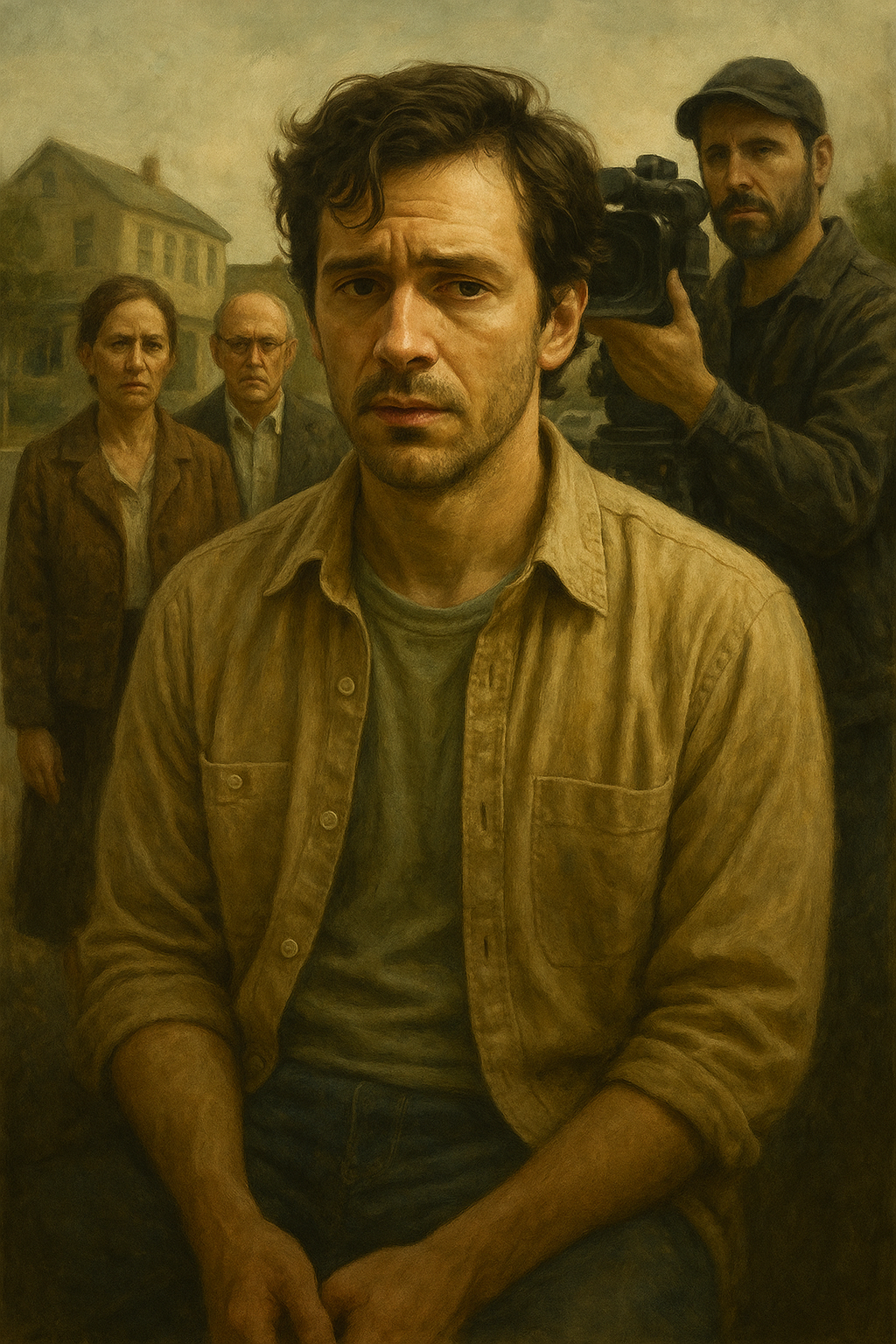
Poster for Endless Rewind

Endless Rewind

A struggling actor in a series of commercials finds himself repeatedly reliving the last moments of each ad he films, where every take pulls him deeper into a self-reflective spiral about his identity and aspirations. Each cut reveals a different aspect of his life, with the presence of the Director haunting him as he tries to discern whether he is merely a pawn in someone else's narrative or the author of his own story. The impossible task of meeting the Censor's exacting standards becomes a metaphor for the actor's battle against his own insecurities.

Graphene
From Deep Cut
Graphene
From Deep Cut
← Back to overview

Endless Rewind

3 chapters · ~12 min read

novella

A struggling actor in a series of commercials finds himself repeatedly reliving the last moments of each ad he films, where every take pulls him deeper into a self-reflective spiral about his identity and aspirations. Each cut reveals a different aspect of his life, with the presence of the Director haunting him as he tries to discern whether he is merely a pawn in someone else's narrative or the author of his own story. The impossible task of meeting the Censor's exacting standards becomes a metaphor for the actor's battle against his own insecurities.

Chapter 1 · ~5 min read

The Final Take

8:27

The light seized the watch face and held it. A rectangle of white so precise it looked manufactured, bouncing off the polished steel in angles that had been calculated down to the millimeter. The kind of white that costs money. The kind of white that only exists in rooms where people have been paid to make it exist. Felix held it at chest level, the way the Director had shown him. The way the storyboard had illustrated. His hand was steady. That part was working.

Around him, the studio breathed with a low mechanical hum. Softboxes on rigs. A boom arm positioned somewhere above and to his left. A monitor bank somewhere beyond his sight line, where the Director sat, where the Censor's voice would come through the speakers if the Censor had something to say. The Censor wanted a man who had everything and wanted nothing. Or wanted everything and had nothing. Or something Felix couldn't quite hold in his head long enough to become it. This was the fifth booking. Fifth commercial in three years. Not a lot. Enough to know the shape of the thing. Enough to know where he was failing. The Director's assistant, a woman named Margot with a clipboard and the posture of someone who had seen this exact moment happen a hundred times, stood just outside the frame. She was watching his hands. Everyone watched his hands.

"Rolling," someone called. A man's voice. Not the Director. Felix felt the red light somewhere he couldn't see. He knew it was on. The camera was on. He was supposed to be a man in an airport. Or a hotel room. The location didn't matter. The location was supposed to feel like everywhere and nowhere. Successful. Alone. Beautiful in the way that expensive things are beautiful, which is to say untouched. He brought the watch to his face. The light fractured off its surface again. In the real world, in the world before this room, he'd eaten a protein bar five hours ago. His shirt was pressed. His hair had been touched up by a stylist who hadn't spoken to him. He was supposed to look like a man who had never been hungry. He was supposed to look like a man who had nothing to prove.

The Director had explained it this way: "You're waiting for someone who's never going to arrive. But you're not sad about it. You've made peace with it. You have the watch. The watch tells you the time. The time is always now. That's the message." Felix had nodded. He'd understood the words. Understanding the words and being the words were not the same thing. "Let's hear it," the Director said. His voice came from the darkness beyond the lights, a rough alto that never seemed to arrive with warmth. "Give me the line." Felix looked at the watch. Looked at the camera. Looked at the space between them where an imagined audience sat, waiting to see if he believed what he was about to say. "Some things," he began, "you can't rush." The silence that followed had texture. Weight. Opinion.

"Again," the Director said. "You're acting at us. I can see you deciding to say the words. I need you to know the words." Felix's shoulders rounded inward. He reset. The assistant had moved closer, clipboard lowered, and he understood that she was watching for something specific. A crack. A tell. The moment the facade split. "Some things," he said again, "you can't rush." It was the same words. He could hear the difference. The first time he'd been reaching for truth. This time he was reaching for the idea of reaching. It was worse. "Cut. Reset." The red light went dark somewhere he still couldn't see. Margot was moving. Someone handed him a towel. The towel was cold against his neck. He hadn't sweated. He didn't think he'd sweated. But the towel was there anyway, which meant someone had decided his body needed it.

“

He was not merely a vessel for this brand message; he was an actor, but did that give him power?

They set up for another take. The Director didn't emerge from behind the lights. The Censor's voice didn't crack through the speakers. This silence felt different than the other silences. This one had a plan. Felix held the watch again. The light caught it again. He was supposed to be a man who had time. He was supposed to be a man who had chosen to stop spending it on the wrong things. He was supposed to look into an imagined face and say a sentence about patience, and that sentence was supposed to make someone want to buy a watch. That was the job. That was all the job was.

He opened his mouth. The words were there. The words were always there. What wasn't there was the thing beneath the words, the thing that would make someone believe he was anything other than a man standing in a studio holding a prop, trying to convince a Director and a voice in a speaker and an audience of strangers and himself that he was someone worth watching. His hand trembled. The watch caught the light. It fractured. It held. It fractured again. "Cut." Margot's voice came through first, tight and professional, speaking to someone Felix couldn't see. The studio lights dimmed incrementally, a slow fade that made the room feel suddenly larger. A door opened somewhere. Footsteps. The hum of the softboxes died.

In the control room adjacent to the studio, separated by a wall of thick glass and a door that locked from the inside, the Director sat motionless in front of a bank of monitors. The largest screen showed a still frame: Felix's trembling hand, the watch fractured with light, his face half in shadow. On a second monitor, Margot's clipboard notes scrolled in real time. On a third, an empty email draft sat open, waiting for the Censor's message to come through. The Director didn't move. Didn't rewind. Didn't play it back. He simply sat with the image, the way a man might sit with a photograph of something he'd already decided about, waiting for confirmation that his decision was right.

Outside the building, in a suburb three hours away, a woman named Claire sat on her living room couch with her laptop open. She was part of the focus group. She'd been selected because her demographic matched the target market: thirty-four, urban professional, watches two commercials per week. She watched the feed as it came through her browser. Felix's face. The watch. The line. The silence after. She didn't know his name. She didn't know he was trembling. The stream was clear enough, but it was compressed, pixelated at the edges, and by the time it reached her screen, it had already been filtered through a dozen decisions about what an audience needed to see. She marked her notes: Authentic. Relatable. Wants to know more about this man.

She had no idea that the man she was watching was, at that exact moment, standing alone in a studio, holding a watch he would never own, wondering if the moment she'd just watched was the moment he'd finally gotten it right, or the moment he'd finally confirmed he never would.

Next · Ch 2 →
The Unseen Critic
Chapter 2 · ~4 min read

The Unseen Critic

7:11

The stage lights were too bright and the back wall was close enough to touch from center stage. Felix held the script but his hands were already shaking. Three days. The Director had called him three days after the commercial wrapped, voice clipped and certain: callback on Tuesday, live rehearsal, you'll do fine. But the Director's definition of fine was a thing Felix had stopped trusting.

David was a man in his thirties who'd lost everything and was supposed to find it again by the end of the monologue. Seven minutes. No net. Felix had not been told the Censor would be here in person, and yet there she was, five rows back in the empty theater, pen moving across a clipboard with the kind of steady rhythm that meant she was writing things down. Things about him. The stage manager had warned him with a look from the wings—a slight widening of the eyes, a tilt of the head toward the back. She'd put down her clipboard.

He could see the words in his mind but couldn't say them. Couldn't remember who was supposed to speak. Felix or David. The monologue began in silence, with David standing at the edge of a room he'd destroyed, a phone in his hand that wouldn't ring anymore. Felix knew this because he'd read it. He'd memorized it. His diaphragm locked. He kept going.

The first three minutes were correct. His voice found the right register, the one that sounded like a man who'd already given up but was still performing the shape of trying. That part was working. His jaw stayed loose. His breath came from the right place. But then the Censor's pen moved faster, and Felix became aware of that motion the way you become aware of a spider on your neck—not because it's threatening but because you can't stop feeling it. Now his awareness sharpened into something else. The stage manager had folded her arms. The Director, somewhere in the dark beyond the lights, wasn't moving.

David's monologue was supposed to build. It was supposed to move from despair into something like acceptance, some kind of peace with the fact that he would never be what he wanted to be. The final section. The part where everything was supposed to change. Felix had practiced this in his apartment for two weeks, alone in front of the mirror, trying to find the moment where the character let go. But standing here under the lights with three people watching him, with the Censor's pen still moving, he couldn't locate it. He could finish. He could get to the end. Except there was no next try here. No reset. No second take.

His voice began to thin. He could hear it happening—the pitch climbing, the breath shortening, the words starting to run together because his chest had tightened and he couldn't get air underneath them anymore. He was aware of that. Which made him aware of being watched. Which made it worse. His hands had started to shake, and now he was aware of the shake, which meant the audience was aware of it, which meant the Censor was writing it down as evidence of his unsuitability. He kept speaking. The words came out but they weren't David's words anymore. They were Felix's panic wearing a costume.

“

This didn’t feel like acting. It felt like exposure.

Then his voice cracked. A small thing, barely noticeable, but in a theater it might as well have been a siren. He pressed on. Two more minutes. He could reach the end of the monologue. He could get to David's final realization and step offstage and let them tell him what he'd done wrong. His throat was closing. His eyes had started to water, which was not in the script. David didn't cry. David was supposed to arrive at peace, not dissolve into it. But Felix couldn't stop it. The tears came, and with them came something worse than failure—the knowledge that he was not good enough for this stage, not good enough for the camera, not good enough to be watched by anyone. He was a hollow thing pretending to be a person.

One more sentence. The final line. David's acceptance. Felix opened his mouth to deliver it and nothing came out. There was no air. There was no character. There was only a man on a stage who couldn't remember why he'd ever thought he was capable of this. Cut.

The stage lights died. The Director rose from the dark and stepped into the aisle, moving toward the stage with the kind of purposeful slowness that meant Felix had done something wrong so fundamental that it couldn't be fixed with another take. But Felix wasn't on the stage anymore. He was in a basement, fluorescent lights flickering on overhead, the rehearsal space revealed as what it had always been: a concrete room with a folding table and a video camera mounted on a tripod. The Director stood in front of the monitor, reviewing the footage. The Censor was beside her, still writing. The stage manager was rewinding the tape.

Felix sat in a metal chair at the edge of the frame, his hands still shaking, his throat still closed. Someone had left a water bottle on the table. Someone else was checking their phone. The Director turned to look at him, and Felix understood, in that moment, that the real performance hadn't ended at all. It was only beginning. And he had no idea what was being recorded, or who was watching, or whether any of this mattered to anyone but him.

← Previous · Ch 1
The Final Take
Next · Ch 3 →
Echoes of the Role
Chapter 3 · ~3 min read

Echoes of the Role

5:01

The commercial played on a monitor set into the observation booth's far wall. Felix watched himself pour a frosted glass bottle with no label he could read. The smile came right on cue, practiced and bright. Behind the glass partition, eight people sat in folding chairs, their faces illuminated by the glow of the screen. The moderator leaned forward slightly. She'd asked them to react honestly, and now she was drawing out the word like it meant something. Honestly. One woman in the back row wrote something on her comment card without looking up. A man in the front crossed his arms. Felix's jaw clenched. His thumbnail found the edge of his nail bed and pressed until it hurt. On the screen, Felix poured and smiled. The gesture looped. The moderator asked what they were seeing. What did the smile tell them.

A younger man spoke first. Said it looked rehearsed. Said the product felt secondary to the expression, like the smile was the thing being sold, not the drink. His voice was even, not cruel. That made it worse. Another woman nodded. She said the performance felt like it was reaching for something it couldn't quite touch. She couldn't explain it better than that. She was sorry. But that's what she saw. Felix's pulse quickened. He knew the feeling she meant. He'd felt it too during the shoot, that gap between intention and execution, the space where sincerity goes to die under bright lights. But knowing it and hearing a stranger name it in a room full of strangers were two different things. The moderator made a note. She asked if anyone felt the smile was authentic. Silence.

One card was turned face down on a lap. Someone coughed. The man who'd spoken first shifted his weight. Felix stood up. His hand pressed against the glass partition. The glass was cold. He could feel his own breath against it. His mouth opened. Something was rising in his chest, a need to explain, to defend, to make them understand the difference between what a camera sees and what a person means when they smile. He knew what they were seeing. That smile was trained into him, one of a dozen variations he'd learned to deploy. It worked on film. It moved product. It didn't look real because selling and looking real were different skills entirely, and he'd spent three years learning which was which. But the words caught somewhere between his throat and the glass. Cut.

The moderator closed her notebook. The fluorescent lights rose. Someone opened a door. The glass was just a wall. Felix was standing in a small observation room in a nondescript building on the edge of the city, and a producer he didn't recognize was walking toward him with her phone already in her hand. She didn't look at him. She was already typing. She said they would need to reshoot. The Censor had flagged something. She said it as though Felix should know what that meant, as though the Censor was a person or a presence he'd met before, as though there was a name and a face attached to the judgment that had just moved through the room like cold air.

“

He felt like a part of someone else’s narrative, no longer an actor but a cartoon—a hollow echo of what he aspired to be.

Felix tried to remember if he'd actually spoken aloud or if the defense had remained internal, suspended somewhere between his ribs and the glass. He replayed the moment, his hand on the partition, his mouth opening, but couldn't locate where one had ended and the other begun. The producer was already moving down the hallway. She turned a corner without waiting to see if he would follow.

← Previous · Ch 2
The Unseen Critic
Back to show →
Endless Rewind